
Scott Fulton explores how emerging technologies and proactive choices can reshape our approach to longevity, healthspan and well-being.
The doom and gloom saga surrounding America’s health and aging outcomes seems endless, but there’s also a vibrant message of real hope. With over a billion people worldwide now exceeding US life expectancy, it points to abundant opportunities for you and me if we can replace subjective comparisons against our contemporaries and US norms with substantive measurements that can transform wealth, health, and lifespan outcomes from aspirations into realities. Several current and emerging technologies offer definitive lane markers to help guide us toward intentional destinations along the amazing journey of life.
“We’re all living longer.” Is it a fact or a compelling marketing slogan? A sharp drop in global child mortality rates between 1850 to 1950 accounts for the lion’s share of lifespan gains, followed by medical advancements, infectious disease treatments, public health education, higher standard of living, and access to better foods. Icn the US, progress slowed markedly in the second half of the 20th century and ultimately flatlined in 2010. In the meantime, the rest of the world kept moving forward, pushing the US life expectancy world ranking outside the top fifty countries, placing it behind every developed country and about 20 emerging countries. The recent global pandemic served to underline an already troubled trajectory. Since 2010, for every American living longer, another is dying younger. This is unprecedented in modern history and unfathomable in today’s advanced society. So, yes, the familiar phrase is accurate, just not for Americans.
Technologies like television, computers, and smartphones are frequently cited as causal, but all of these technologies are prevalent throughout the developed world and can’t explain the US anomaly. Several key factors contribute to the United States’ weak performance, but its #1 ranking in developed countries for the prevalence of both diabetes and overweight adults is a good place to start. Currently, the CDC reports that 48% of adult Americans are prediabetic or type 2 diabetic, and 73% of adults are overweight, obese, or severely obese. These conditions are well-known gateways to chronic diseases guaranteed to shorten life significantly. Diabetes undermines the normal function of every organ and is the underlying trigger of several early deaths, including a 2 to 4‐fold higher cardiovascular disease mortality. Confound the issue with excess weight, and it’s like driving a rusty car overloaded with a trunk full of rocks 24/7 on rough gravel roads. It will shorten its life and require many more repairs than a car operated as designed.
The prevalence of early-onset health issues has normalized them in Western society, along with associated diseases, behaviors, and foods common to a sick society. Americans’ poor health is “common,” but it certainly isn’t “normal.” Herein lies our challenge. With no shortage of persons and institutions to blame, coupled with our conformity and herd behaviors, how do you and I stand a chance?
Fitness tracker smartwatches now start at under $20, with literally thousands of models to match every budget. Most track daily steps, and many are equipped with heart rate monitors and blood oxygen sensors to assess exercise activity, stress, sleep, and VO2max fitness. The power of these devices is their unparalleled ability to provide 24/7 monitoring over weeks, months, and years with no input required from the user other than occasionally recharging. Their broad appeal and adoption have spurred the next generation of smart wearables, fabrics, and patches that monitor blood pressure, blood glucose, ECG, and more. The timing couldn’t be better, as AI leverages machine learning to finally begin making sense of all the health waypoints and excursions for a given individual.
New technologies also make nutrition education easier to learn and adopt. DietID is a mobile app technology invented by David Katz, MD, founding director of the Yale-Griffin Prevention Research Center, that helps users make quick and easy decisions about meal choices. It leverages visual food images with simple better/worse eye-test logic, firmly putting calorie counting into the dark ages. It’s a terrific example of how technology can persistently inform and nudge us toward healthy habits that stick.
High-tech alone won’t move the needle. As Joe Coughlin, PhD, Founder of MIT’s AgeLab points out: “It is the high-touch of social and emotional connection tech can enable that can initiate and, over time, sustain healthy change.” In other words, we need to progressively shift our conformity and herd behaviors to supportive in-person and online communities actively working to move their healthspan and longevity from aspiration to intention. It’s not until we’re in these communities that our gaps in knowledge become self-evident, and new high-value opportunities present themselves.
Smart wearables are also bringing precision health and lifestyle medicine to the forefront. With the support of AI and more touchpoints through remote patient monitoring, health practitioners are discovering that diet, activity, and community prescriptions are often more effective in reducing and eliminating patient reliance on prescription drugs. They also help us balance the Mind, Environment, Diet, Activity, and Community (MEDAC) foundations for optimal aging.
Together, these technologies help put us on a course to proactive lifestyles that add a bonus decade of active living along with dramatic reductions in dementia, heart and stroke, and several cancers, and preserve our wealth for living and our legacy. With about 85% of our longevity outcomes attributed to lifestyle and only 15% due to genetics, the wealth, health, and lifespan trifecta comes down to choice, not chance. I get to see this at work in my adult students. Too old, too set in their ways, too technology averse? A resounding NO on all counts. Technologies that inform and guide us easily to supportive communities and better outcomes will always be in great demand.
About Scott Fulton
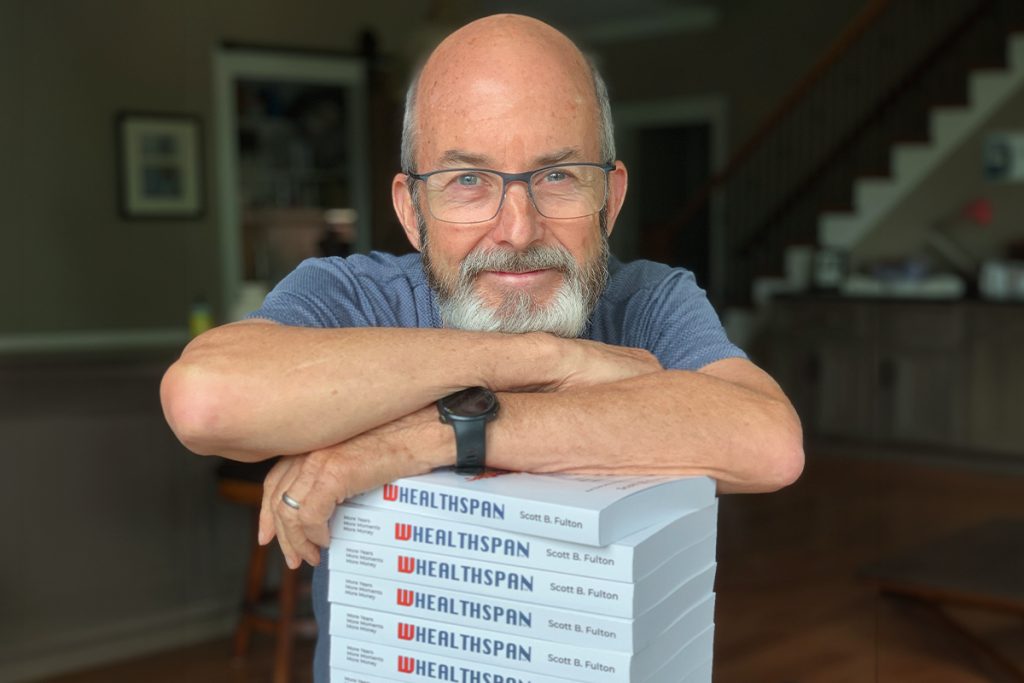
Scott Fulton is an internationally recognized Redefiner in the positive aging space. Accustomed to big systems engineering challenges, Scott focuses his research on improving adult aging outcomes. He teaches Lifestyle Medicine and Aging at the University of Virginia and the University of Delaware and is invited to teach concurrently at 50 institutions in 2025. Scott is an American College of Lifestyle Medicine member, sits on the prestigious True Health Initiative Council, and is past president of the National Aging in Place Council. His critically acclaimed book, WHEALTHSPAN, More Years, More Moments, More Money, hit #1 on Amazon, and he is known for creating the MEDAC system for optimal aging. Scott is a multiple Ironman triathlete and always has several exciting projects in the works. He lives with his wife in Charlottesville, VA, in a demonstration home they recently designed and built for the future of optimal aging across a lifespan.
References:
https://ajph.aphapublications.org/doi/full/10.2105/AJPH.2023.307310
https://www.cdc.gov/obesity/php/data-research/adult-obesity-facts.html
https://www.niddk.nih.gov/health-information/health-statistics/overweight-obesity
https://www.cdc.gov/nchs/fastats/obesity-overweight.htm
https://www.ahajournals.org/doi/10.1161/JAHA.118.011295

