
New research from Gero suggests that aging may be driven by entropy, providing a fresh perspective on age-related disease and mortality.
In a recently published study in Aging Biology, researchers from the biotech Gero have proposed a pioneering model of aging that centers on entropy, the tendency of complex systems to move toward disorder. This model, based on the Second Law of Thermodynamics, posits that as humans age, a gradual accumulation of irreversible molecular changes – driven by entropy – increases the likelihood of age-related diseases and mortality. Gero’s findings offer a new lens on biological design, providing an interesting perspective on aging and understanding more about the role entropy plays in determining lifespan and aging may point toward promising avenues for therapeutic interventions that could significantly extend human healthspan.
Longevity.Technology: Entropy, a fundamental concept in thermodynamics, describes the irreversible tendency of systems to evolve from order to disorder over time. Applied to biological aging, entropy manifests as cumulative molecular damage, such as DNA methylation errors and mutations, that accumulates progressively in cells throughout life. This accumulation gradually impairs the body’s ability to maintain homeostasis, accelerating disease susceptibility and mortality risk. While cellular reprogramming and senolytic drugs can address some manifestations of aging, they do not reverse these entropy-driven changes, which is what sets Gero’s approach apart.
The study leverages data from extensive human datasets, including DNA methylation profiles and longitudinal medical records from the UK Biobank, to model how entropy impacts biological systems. The Gero team demonstrated that entropy-based aging accumulates in humans differently from short-lived organisms, such as mice, that tend to succumb to genetically programmed aging before substantial entropic damage builds up [1].
As Dr Peter Fedichev, Gero’s CEO, explains: “Our work offers a clear path forward to designing effective therapeutics aimed at the aging processes. We believe that within the lifetimes of those alive today, we could develop therapies to radically slow or stop aging.”
An entropic aging model
The research emphasizes the critical role of entropy in human aging by categorizing the underlying drivers of age-related decline into two distinct mechanisms. The first mechanism is age-related diseases – system failures such as hypertension – which are individually identifiable and often treatable. However, the second mechanism is microscopic damage that accumulates at the molecular level. This type of damage results from imperfect cellular repair processes, making it irreversible with current technology.
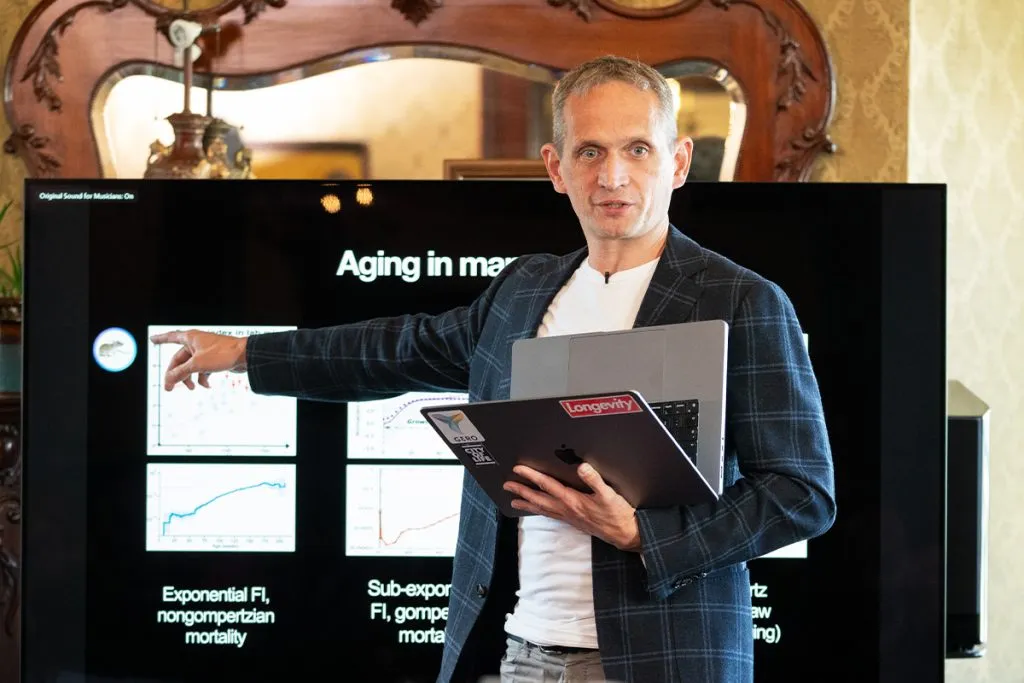
This model brings into question the efficacy of using mice as proxies for human aging research. Mice, which have short lifespans, primarily succumb to age-related diseases before entropic damage can significantly impact their longevity, but in contrast, humans have the capacity to control age-related diseases, allowing for the gradual buildup of entropy-driven molecular damage over a much longer timeframe. This insight, as Fedichev has noted, highlights why: “mouse studies are a poor way to understand human aging; mice and humans age in fundamentally different ways.”
Implications for therapeutic development
Given the limitations of traditional animal models, Gero’s research represents a shift toward using human data to study human aging. Fedichev, who holds PhDs in theoretical physics, explains: “In physics, we don’t need to understand every variable to grasp a system’s behavior. Just like thermodynamics helped design steam engines well before people agreed about the existence of molecules, we can use statistical physics to simplify biological complexity and drive progress in aging research.”
Fedichev told Longevity.Technology that in the new study, Gero’s scientists propose a quantitative theoretical model linking the dynamics of regulatory interactions and configuration transitions to mortality acceleration and aging – complexities, he explains, that are difficult to capture in short-lived species.
He told us that Gero’s use of human medical data is essential for overcoming the limitations of animal models like mice, where aging is characterized by a dynamic instability of tightly correlated features – hallmarks of aging – and, as a result, short treatments with antiaging drugs in mice often produce lasting, rejuvenating effects.
“In contrast, human aging is primarily entropic, resulting from a vast number of independent, age-related changes that manifest differently across individuals and systems.” he explained. “By using extensive longitudinal datasets such as electronic medical records from the UK Biobank and DNA methylation (DNAm) data, Gero can directly study both the stochastic and deterministic components of human aging.” He added that this approach allows the identification of therapeutic targets that hold the potential for the maximum healthspan and lifespan extension.
Target acquired, Geroing in
Using this entropy-based model, Gero has identified specific molecular targets that may play a role in regulating the entropic processes underlying aging [1]. By manipulating these targets, the researchers hope to create drugs that can slow entropy accumulation, thereby extending the period of life during which individuals remain free from major diseases.
Fedichev told Longevity.Technology that the new discovery “fundamentally shifts” our approach to developing therapeutics for age-related diseases by highlighting the entropic nature of human aging.
“Unlike mice, where aging is primarily a reversible dynamic instability – a regulatory error catastrophe – aging in humans is a complex, mosaic process across different systems and cells, making it far more challenging to control or reverse,” he explained, adding that senolytics and cellular reprogramming, which target specific hallmarks of aging, are effective in simpler models like mice but may be insufficient in humans.
Age-associated changes are entropic in humans, differing across tissues and cells,” he explained. “Targeting individual features does not guarantee broader effects.”
Gero’s model further suggests that these entropy-driven changes impose constraints on the possibility of reversing aging entirely – as covered in Fedichev’s exciting debate with gerontologist Aubrey de Grey. Although interventions such as cellular reprogramming may add years to life, say the authors, they are unlikely to extend it beyond a certain limit – estimated to be approximately 120 years – due to the irreversible nature of entropy-based molecular damage. Fedichev explains: “Even though living organisms are open systems, the data analysis shows that the second law of thermodynamics commanding entropy increase puts very specific limits on rejuvenation possibilities.”
A paradigm shift on the horizon…
So, could slowing entropy-driven damage make radical life extension a possibility? Fedichev explains that the key challenge lies in the different roles that irreversible (entropic) and reversible aging features play in regulating lifespan across species.
“Since mice are our primary pre-clinical model, focusing on reversible aging phenotypes may lead us into a regulatory trap: selecting drugs with maximum effects on lifespan in mice may result in choosing interventions that have limited, short-lived effects in humans,” he told us. “Follow-up studies have shown more examples of interventions that extend life in mice but do not affect the entropic aging component in the same species.”
Aging research needs to consider entropy-driven molecular damage rather than solely focusing on reversible aging mechanisms. While therapies targeting specific aging markers may provide temporary benefits, Gero’s model makes the significant point that a more profound approach – slowing the entropic processes at the cellular level – is essential to unlock significant gains in human healthspan and lifespan

