
China’s speed, scale and infrastructure are central to Insilico’s ambition to build a ‘digital Einstein’ for faster, cheaper drug discovery.
Now more than a decade into its AI drug discovery journey, Insilico Medicine, is chasing an audacious goal: building an artificial intelligence (AI) system smart enough to rethink how medicines are discovered.
Founder and CEO Alex Zhavoronkov calls it a “digital Einstein” for drug discovery, a system that can connect dots across biology, chemistry and data in ways humans simply cannot.
Yet Zhavoronkov is quick to temper the hype. “Biotechnology is a high-risk field like a ‘molecular casino’,” he said, speaking to the South China Morning Post. “Even with artificial intelligence, you can lose 90 percent of the time [1].” The promise of AI, in his telling, is not certainty but better odds.
Insilico’s timing matters. The company just raised US$293 million (HK$2.28 billion) through its Hong Kong IPO this week, drawing in cornerstone investors including Eli Lilly, Schroders, Tencent and Temasek. Nearly half of the proceeds will go directly into research and development, a signal that investors are backing long-term scientific ambition rather than quick returns.
For Insilico, China is not just another market, but the engine room of its strategy.
“The most efficient [biotech] companies in the world are in China. If you are not competing in China, you are not competing [globally] at all. If you are not in China, you are not relevant,” Zhavoronkov said [1].
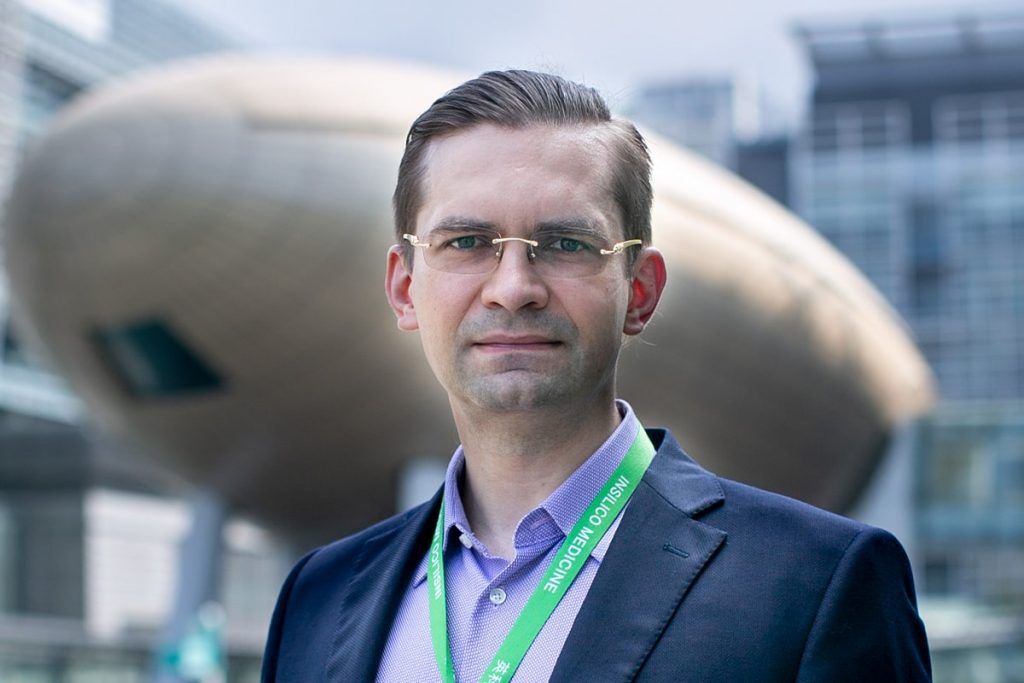
In Shanghai’s Zhangjiang science hub, Zhavoronkov points to a rare concentration of capability: chemists, biologists and testing facilities operating in one place. Drug molecules can be designed, synthesized, tested in cells and studied in animals without ever leaving the site. For AI-driven drug discovery, where speed and iteration are everything, this matters.
The economic impact is substantial. Faster cycles mean lower costs and quicker decisions on whether a drug candidate is worth pursuing, a critical advantage in an industry known for long timelines and high failure rates.
Traditionally, getting a drug candidate to the preclinical stage can take more than four years, often ending in failure. Insilico says its AI-powered platform, Pharma.AI, has cut that timeline to between 12 and 18 months. In one case, the company reached a key milestone in just nine months.
The record came through a collaboration with China’s Fosun Pharma on ISM8207, an immuno-oncology drug. The deal brought Insilico a US$7 million upfront payment in 2022, with up to US$48 million in milestone payments tied to progress.
So far, the company has developed 23 drug candidates using its platform. Two are now in Phase II trials, one targeting lung disease and another inflammatory bowel disease.
None have reached the market yet, but Zhavoronkov says the projects have achieved “100% success to date going from development candidate to Phase I trials [1].”
Insilico’s technology is about starting fresh. Instead of scanning existing libraries of chemical compounds, its generative AI reads biological data – including genomics – and designs new drug molecules from scratch. For non-scientists, the idea is similar to asking an AI writer to produce an original essay rather than editing an old one.
Over time, Insilico plans to open parts of this system to others. Zhavoronkov expects some AI capabilities to become available within three to five years, potentially through subscriptions costing around US$20 a month. The goal is to let other biotech and AI firms move faster too, creating an ecosystem rather than a closed shop.
Insilico’s financials underline the risk. Most of its revenue comes from licensing drug candidates, with a smaller share from selling AI software. In the first six months of this year, it reported a net loss of US$19.22 billion, compared with a net profit of US$8 billion a year earlier.
For investors, the losses are part of the story. Drug discovery is capital-intensive, and AI does not eliminate failure; it only reduces it.
The company plans to use 15% of its IPO proceeds to develop new AI models, and the rest to expand automated laboratories and support global growth, including further expansion in China next year.
Insilico already operates across Hong Kong, Canada, the Middle East, Shanghai and Taiwan. Its partnership with HKIC includes plans for an AI-driven drug discovery incubator in Hong Kong, with “Hong Kong first” access to new projects.
“Our long-term vision is to be like McDonald’s for drug discovery. Set up research sites around the world so that countries can convert money into drugs, and drugs into life,” Zhavoronkov said [1].
China, for now, remains central to that vision, not just as a market or manufacturing base, but as the proving ground for whether AI can truly change how medicines are made.

