
In 2021, I interviewed James Clear on The Drive to talk about his book “Atomic Habits,” and the podcast was so popular that we have re-released it around New Year’s Day every year since. Last year, we took the extra step of publishing a special newsletter in which we summarized some of James’s insights and illustrated them using specific examples from recent podcast episodes. The piece served as a companion to last year’s re-release of the podcast interview, and we’ve decided to repeat the pairing again this year—with a few updated examples from this past year’s podcasts—to keep the information fresh and demonstrate just how widely these principles apply when it comes to health and wellness.
The four steps to developing a habit
Your health goals are probably easy to articulate, but your “system”—the collection of habits that you regularly follow—is what will ultimately determine whether you reach them. As James explained on the podcast, a large amount of our behavior (40–50%) is automatic and habitual, and we are building habits all the time whether we are consciously aware of it or not. Forming good habits is an essential part of both my clinical practice and my approach to my own health and life. While our ultimate goal is to change behaviors, we have to start with forming habits. A series of small and easy changes can collectively make a very big difference.
The key to James’s advice is to follow four “laws” to incorporate an action into your routine so that it becomes a habit: 1) Make it obvious; 2) Make it attractive; 3) Make it easy; and 4) Make it satisfying.
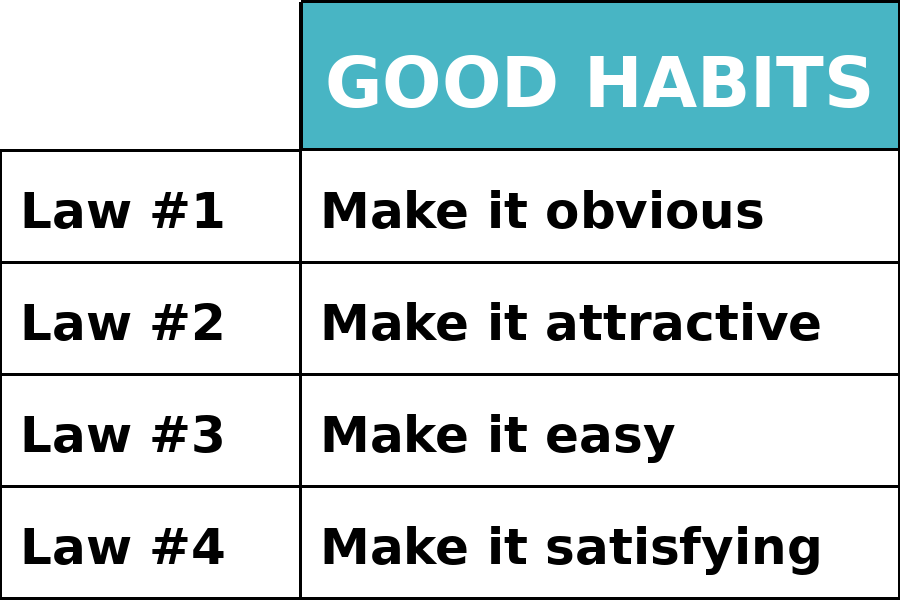
In this newsletter, we’re going to go through each of these elements and apply them to some of the actionable health advice we received from guests on The Drive over the past year.
1. Make it obvious
Cues promoting a good habit should be easy to spot and grab one’s attention. For example, if you want to run each morning, put your running shoes by the door as a visual reminder. Of course, this step requires you to first identify such potential cues. Ask yourself what visual reminders would help you and where in your home, office, car, or anywhere else they should be.
Drs. Tanuj Nakra and Suzan Obagi promoted this strategy on the podcast this year in our discussion on skincare and facial aging. During our interview, these specialists brought up a number of ways to protect the face from the signs of aging, such as regularly applying mineral sunscreen or using a nightly retinoid treatment. Though these strategies require relatively low effort, each still constitutes one more chore to remember and stick to, so Suzan suggested adding a visual cue until it becomes routine: “Right next to your toothbrush, put your little tube of retinoid.” For most of us, brushing our teeth is a nightly ritual, so by placing skincare products near the toothbrush, we have a visual reminder to incorporate the latter into our pre-bedtime routine.
2. Make it attractive
We all intuitively know that making something appealing or exciting will increase our motivation to do it. Your social environment is very important in determining how attractive something is, especially in the long term. If your goal is to stop drinking, going to bars with your martini-loving friends is going to make you miserable and undermine your goal. Having an alcohol-free game night at your house, though, can help you to break the association between drinking and fun and offers the added bonus of the anticipation of having friends over. (Indeed, one of the most effective ways of making a new habit attractive is to involve friends who are interested in making similar changes in their own lives.) The physical environment is important in developing habits, too. If your goal is to eat more vegetables, make sure your pantry isn’t full of tempting junk food and that your fridge is stocked with your favorite vegetable-based snacks.
Making tasks more attractive is also a great way to motivate kids toward beneficial habits. Joe Liemandt, a former software engineer who now devotes his attention to reimagining K–12 education, co-founded the Alpha School in part based on this principle. As he explained on the podcast, incorporating evidence-based, AI-driven apps as educational tools fosters greater excitement than traditional lecture-based classes and motivates students to become more actively engaged in learning. In other words, making education more fun builds the habit of active learning.
Dr. Kyler Brown also utilizes the “make it attractive” strategy in sports rehabilitation and for untrained individuals by taking into account not only the needs of his clients, but their preferences as well. “If I just try to convince you to do an exercise you hate doing, it’s not going to last,” he says. For instance, if you need to improve your cardiorespiratory fitness but can’t stand running, simply switching the training modality to cycling or swimming can make cardio sessions more attractive without diminishing their impact.
3. Make it easy
Convenience and simplicity make it more likely that you will perform a behavior regularly. James gave an example of a man who went to the gym for six weeks but only stayed for five minutes; he made going to the gym much easier by focusing first on the habit of getting there, without concerning himself with the more intimidating task of working out for an hour. The “two-minute rule” can also be useful when you are getting started: condense the habit you want to start into something that takes two minutes or fewer to do. This feels much more manageable and allows you to gradually build up as each step feels easier to do.
As Dr. Rhonda Patrick discussed in her most recent appearance on The Drive, most individuals could benefit from eating more protein—which is necessary for building and maintaining muscle—and optimal intake is likely at least 1.6 g/kg body weight/day (double the current Recommended Dietary Allowance) for typical adults. But getting this quantity of protein each day often requires dedicated effort, especially if we’re trying to do so without significantly increasing intake of saturated fats and total calories. So how do we “make it easy,” or at least easier? A simple strategy is to replace some of our usual snacks with high-protein options—jerky or nut mixes instead of chips or crackers, protein bars instead of cereal bars, etc—and keep these protein snacks in easily accessible areas of the kitchen or at your desk at work. Stock the fridge with turkey cold cuts or keep canned fish in the pantry to make sure you have easy protein options to add to salads or sandwiches on busy weeknights.
4. Make it satisfying
Tracking your progress and seeing the improvements that come with your new habit will provide a strong motivation to keep progressing towards your goal. Last year, I mentioned that I’d recently purchased a portable VO2 device and was using it to track this metric for myself, which added to my enjoyment of exercising. Likewise, seeing your resting heart rate decrease or muscle mass increase over time can be very satisfying readouts that your efforts in the gym are working. But satisfaction doesn’t always need to come from quantitative metrics or even from gradual improvements over long time frames—for some habits, the satisfaction can be more direct.
In my recent discussion with Dr. Sally Greenwald, a gynecologist and expert in women’s sexual health, she proposed that women should incorporate vaginal care into their everyday routine by applying lubricant and vaginal moisturizers on a daily basis—analogous to how they might apply sunscreen or facial moisturizers to care for their skin. As Sally explained, these practices can help to ensure long-term health of the vagina but also have the more immediate reward of reducing pain and enhancing pleasure during intercourse. In other words, building this particular habit can lead fairly directly to greater sexual satisfaction.
Obviously, many (if not most) of the habits we hope to build may not have this sort of rapid reinforcement, but even in those cases, we can often help ourselves by creating short-term rewards to pair with our desired behaviors. Imagine buying yourself a new outfit after a month of successful weight training or splurging on a new sound system after redesigning your environment to support healthy eating and keeping it that way for six weeks. However, we must be careful to ensure the rewards are consistent with the overall goals: don’t buy yourself ice cream as a reward for losing weight or a more comfortable couch for becoming physically active.
Breaking Bad Habits
Just as it’s important to develop good habits, it’s often necessary to break bad ones. Unsurprisingly, the steps for breaking a bad habit are the reverse of the four laws for developing good ones.
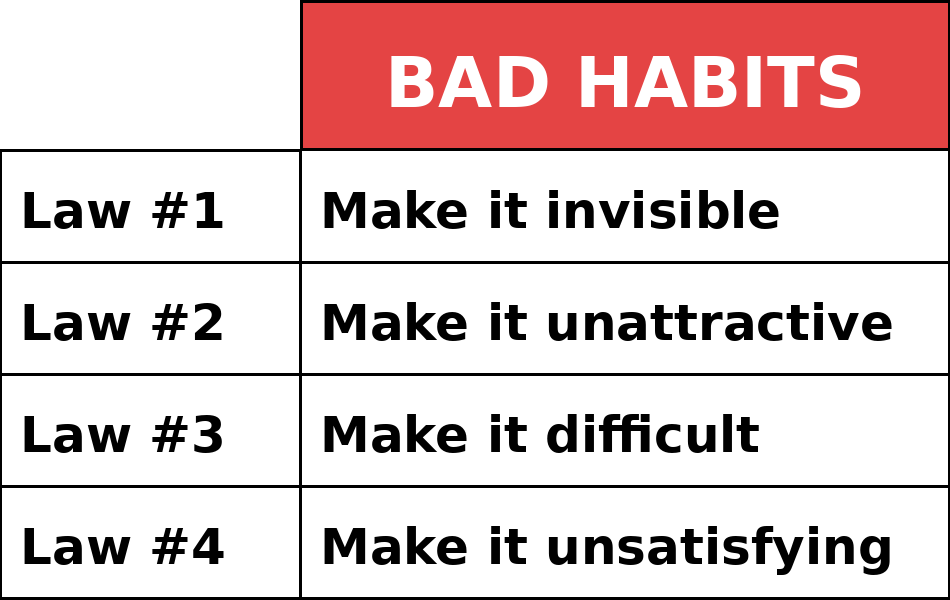
In my conversation with sleep expert Dr. Ashley Mason, she emphasized the critical importance of associating bed and the bedroom space almost exclusively with sleep—rather than with scrolling through social media, checking emails, or watching television, for instance. But for many, reaching for our digital devices even as we crawl into bed has become a habit that is difficult to break—providing us with an excellent example of how to employ James Clear’s “anti-rules” to move away from this undesirable pattern of behavior.
Perhaps the easiest steps to take in this case are “making it invisible” and “making it difficult.” For instance, you might remove your devices from sight an hour or two before bed by stowing them in a desk or nightstand drawer, and keep your phone out of arm’s reach of your bed such that you’d need to get up and walk across the room in order to check it. Another strategy might be to shut down your phone or tablet entirely before bed such that you’d need to put forth the time and effort to reboot it again for use (some devices allow you to schedule automatic on/off times). “Making it unattractive” is also relatively simple—delete games and social media apps such that you have fewer tempting options for deriving entertainment and endless dopamine hits through your device. Finally, to “make it unsatisfying,” we might try setting up alerts on the device to chastise us when we use it during predetermined “quiet hours,” or we might take note of dips in sleep quality metrics on nights when we fall asleep just after watching a horror film or spending an hour on stressful work emails.
The bottom line
Setting up good health habits now can enhance your healthspan and likely your lifespan, too. The “laws” we learned from James Clear can help us apply the lessons we learned from the other podcast guests. In our podcasts, we aim to provide you with actionable steps to put the science of longevity into practice. As we enter a new year, think about the health goals you’d like to reach and the “atomic habits” that will help you get there. Happy New Year!
Podcasts cited in this newsletter
#183 – James Clear: Building & Changing Habits – Peter Attia (November 8, 2021)
#355 – Skincare strategies, the science of facial aging, and cosmetic-intervention guidance | Tanuj Nakra, M.D. & Suzan Obagi, M.D. (June 30, 2025)
#366 ‒ Transforming education with AI and an individualized, mastery-based education model | Joe Liemandt (September 29, 2025)
#350 ‒ Injury prevention, recovery, and performance optimization for every decade | Kyler Brown, D.C. (May 25, 2025)
#341 – Overcoming insomnia: improving sleep hygiene and treating disordered sleep with cognitive behavioral therapy for insomnia | Ashley Mason, Ph.D. (March 24, 2025)
For a list of all previous weekly emails, click here.

