
Amid increasing concern over the validity of longevity supplements widely available online, there are growing calls for better industry standards.
The longevity supplements business is booming – the worldwide market for antiaging supplements is expected to reach approximately $2.3 billion by 2030. A quick online search for NAD, Urolithin A or spermidine will yield hundreds of results – giving consumers a wide range of choices – and prices. However, a potential crisis is brewing. The recent publication of studies by Sandalova et al and others have raised concern about product quality, labelling accuracy and the validity of marketing claims made by some supplement providers.
The Sandalova study uncovered substantial deviations between the labeled and actual contents of longevity supplements purchased online, with some products found to contain no active ingredients at all. The report authors highlighted the pressing need for stricter regulatory oversight to ensure consumer safety and product efficacy. But what do the supplement makers themselves have to say on the matter?
Longevity.Technology: The recent studies show that self-regulation is clearly not working in the longevity supplements market. Surely, at the very least, consumers deserve to receive products that actually contain the material stated on the label. And surely these basic standards need to be enforced in the enormous online sales area to allow consumers to make informed decisions? To get a vendor’s perspective, we spoke to Dr Patrick Keohane, co-founder of Chrysea, a company aiming to bring pharmaceutical standards to the development of nutritional supplements.
Chrysea is an early commercial stage synthetic biology company focused on precision nutritional supplements designed to support healthy lifespan. By committing to quality and rigorous validation, the company aims to set a new standard in the industry, advocating for this to become the norm for both large and small enterprises.
“I think it is reasonable that minimum standards are used in the supplements industry, in the same way that there are minimum standards for beer, breakfast cereals or even lipstick,” says Keohane, who heads up Chrysea’s clinical development operations.

All those products must have a certain level of testing and include the specifications somewhere on their label. And in most countries, there are guidelines and requirements that are enforced for things like the fat and salt content of foods.
“Those are practices that can be adopted in supplements – basic safety, basic product quality, reproducibility, who wouldn’t want to see that in the food supplement and ingredients industry across the board?” says Keohane. “Not just for large brands, but for all consumer products sold direct to consumer, who are no less important than the consumers who buy branded products from large organizations.”
“If consumers had a higher probability of buying quality products in which they would trust and buy again, and again, I think it would benefit the industry long term, including the platform companies, the oversight agencies, and other key players in the consumer environment.”
Enforcing current regulations would be a start
Of course, regulations around longevity supplements do already exist. In the US, for example, supplements can be classified as Generally Regarded as Safe (GRAS) or as a New Dietary Ingredient (NDI), but the enforcement of these regulations, particularly on online platforms, is sketchy at best.
“There are actually very few products on the large online platforms that have GRAS approval,” says Keohane. “There are products that infer GRAS approval or equivalent, but that is where a lot of the opacity and the gaps are. What Elena Sandalova and others have found, including our own experiences testing products available online, is that some brands do not appear to have any active ingredient in them, while others do not have the level of ingredient as specified on the label.”
In its own research, Chrysea purchased six products online that are available to consumers in the US and tested for bioactives in the lab.
“We could not detect any bioactives at all in two of the six products and other products contained chemical residues or other things which should not be in those products,” says Keohane. “That is disingenuous to the consumer, and it does not build trust in the industry.”
Keohane feels that the industry itself could take a lead role in effecting change, particularly regarding online platforms, online sales and the oversight of product labeling and verification.
“Regulatory agencies are pressed to do many things for which they are not necessarily resourced, and the management of regulations regarding supplements could be a lot stronger.”
Although he acknowledges that some platform companies are making efforts to manage this – Amazon’s introduction of the need for a certificate of analysis, for example.
“Of course, that’s not always being handled in a professional way by some players in the market,” he says. “But we, along with others, are trying to change that, because we want to build trust with the consumers.”
‘Big players’ should take the lead
The current commercial environment, particularly online, makes it harder for a small company with limited resources like Chrysea to justify the investments in time and money, product development, preclinical safety testing and regulatory approvals, all of which are expensive and time-consuming processes. And the opportunity cost of not having product on the market while spending time doing a GRAS or novel food application is considerable.
“For small companies like us, and we’re not alone, taking our approach is not helped by the commercial environment, where a great number of products are available online, but very few have had the kind of process and quality scrutiny that we believe consumers in this area and others should expect,” says Keohane. “But that’s the barrier that we must overcome, in terms of educating various third parties of the importance of having a credible, verified, quality product. And being sure that what you buy, is what it says on the label.”
One of the key issues for Keohane is that consumers tend to have a high level of trust when it comes to online sales platforms regarding the products sold on them. Chrysea is calling on larger organizations that manufacture quality products, as well as big brands, who have a reputation to defend and who want to use quality products, to take stronger positions with online vendors, who sell a great number of small volume products of questionable quality.
“For many consumer products there is enforcement by various mechanisms of checking that what’s on the label is what’s in the box,” says Keohane. “But the area of longevity supplements is opaque at the moment, and I think it’s time to bring this issue to the attention of relevant large players. Bring their attention to the fact that consumers in this environment deserve as much as they already get in other consumer product environments. This is a complex issue that requires sustained intervention by relevant third parties. And that will take time. But if you don’t start, you don’t finish.”
Referring to the recent papers highlighting the scale of the problem, Keohane says that change is needed to ensure the long-term viability and credibility of the industry.
“First and foremost, there is a need for consumers to be able to trust the products that they see online,” he says. “It’s not cheap to buy these products, but also as the longevity and successful aging industry develops, it is important that products are quality and trusted, and consumers feel they get value for money.”
Keohane also believes that if products are quality and trusted, then that would also draw more informed investors and scientists into the field to accelerate the development of interventions to help longevity and successful aging.
“So, what can we do things in terms of oversight of commercial activities and online practices to encourage that?” he asks. “Well, we can’t change that on our own, but we can draw the attention of larger players who might be able to help change those things.”
Leading by example
From Chrysea’s perspective, building trust is all about ensuring that a supplement is high quality and supported by a weight of evidence of safety and health benefits. Much more than the anecdotal claims that accompany many consumer products today.

“We have invested time and money in developing a process that’s sustainable and that reproducibly gives us pure product,” says Keohane. “We’ve done the preclinical safety testing and studies in real people, and we’re generating data that demonstrates the benefits of our products to publish papers on.”
For a small company like Chrysea, doing all the above for all its supplement products is a significant undertaking. And, stresses Keohane, not something that is obvious to consumers.
“When we do consumer panels in the US, one of the common comments from consumers is that they expect when they see a product online that its safety has been tested,” he says. “They expect that it’s had some studies in people and that there’s been some third-party validation. All perfectly reasonable expectations, but often lacking in reality.”
A significant part of Chrysea’s strategy is to invest in the quality of its products – to put them before third parties, like a GRAS expert panel, and to submit to the regulatory bodies for the certifications that demonstrates that quality to consumers.
“We believe that if we are going to ask consumers to pay for something, then we must also provide third-party validation of our process and the product quality,” says Keohane. “And we would like to see that become the norm, rather than an exception.”
First stop, spermidine
Chrysea’s research is centered on enhancing autophagy – a critical cellular process responsible for recycling damaged structures and maintaining cell health – which ultimately led to its initial focus on spermidine.
A naturally occurring compound synthesized within human cells through the polyamine biosynthesis pathway, we all consume spermidine in our diets – from nuts and fruit and vegetables, cheese and other sources. Spermidine plays a crucial role in regulating cellular processes, influencing everything from gene expression to protein function. Recognized for its ability to induce autophagy, there is extensive research indicating that it plays a key role in health, and it has been linked to reduced risks of cardiovascular disease, neurodegenerative disorders and even certain cancers.
“There is plenty of evidence that it’s biologically important – there are something like 14,000 publications on the molecule in multiple species,” says Keohane. “It’s highly conserved in cell systems, and there’s a lot of preclinical data showing that higher levels are important in cardiovascular health and in immune function, and also a lot of emerging area about gut health and the microbiome.”
Beyond autophagy, research suggests spermidine also plays a role in modulating inflammation and lipid metabolism, contributing to cardiovascular health and longevity. Spermidine also exerts influence through epigenetic regulation, modifying gene expression without altering the DNA sequence, which contributes to its wide range of biological effects.
However, despite all the preclinical studies, Keohane explains there hasn’t been a lot of human research by comparison, partly because pure spermidine hasn’t been available.
“The human research to date has always been based on supplements made from extracts, which only contain 3% or 4% spermidine,” he says. “It’s only now that we’re starting to have all the tools needed to really accelerate the human research and generate evidence that could parallel what exists in studies in other species.”
Introducing Sprevive: pure spermidine
Chrysea began commercialization and sales of its lead project Sprevive this summer. Sprevive is the first and only pure spermidine product to have GRAS self-affirmed status, with additional regulatory filings ongoing or planned in multiple geographies around the world.
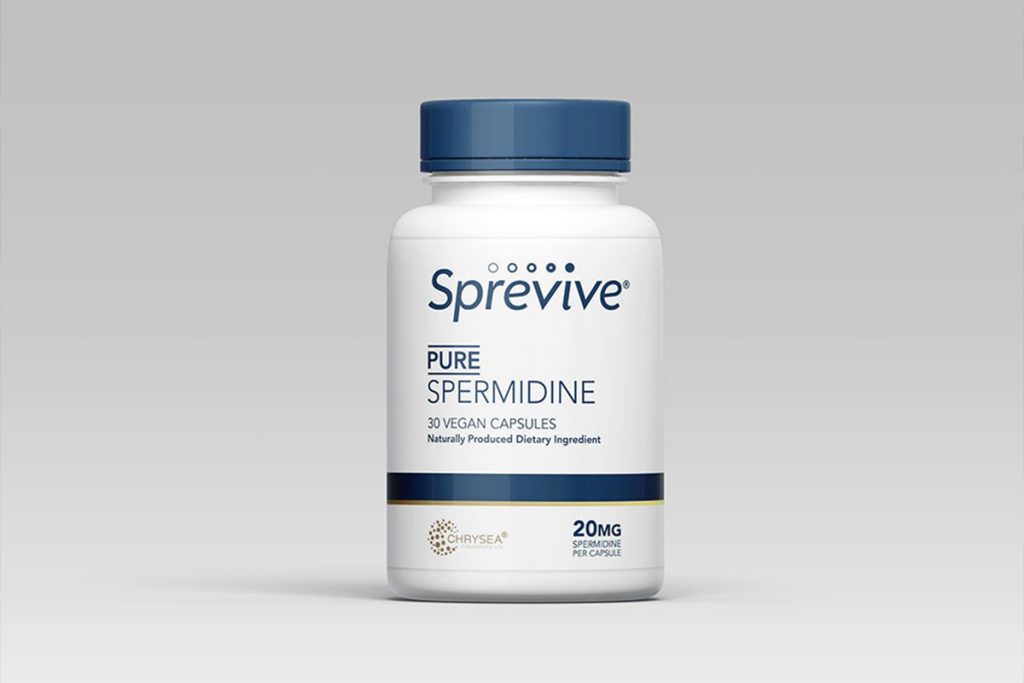
“The purity of our product is key,” says Keohane. “Most spermidine supplements are plant extracts of variable low-concentration or produced by even less sustainable methods like chemical synthesis. In addition, they may contain ingredients that have been shipped from another country, which may not have the standards of Europe or the US, for example.”
Sprevive is a perfect example of how Chrysea plans to conduct its business in the world of longevity supplements. The company is now looking to leverage its pure product to conduct additional clinical trials with dosage levels previously impossible to achieve. But the company is also conducting extensive research using existing databases to find out more about the impact of spermidine in humans.
“There are some very large databases, which contain a lot of relevant dietary intake demographics and biomarker data, and we are trying tease out, using various mechanisms, how this molecule might be generating benefits in people.”
By way of an example, Keohane points to the findings of the Bruneck study, a 20 year observational study of 100 Italians, which showed a statistically significant association between higher spermidine intakes and lower all-cause mortality, and particularly cardiovascular mortality.
“Of course, you can’t assume cause and effect, but it’s a signal that the animal data may well have relevance in humans,” he says. “We’re also looking at large databases, to see which groups might have higher intake normally and lower intake normally, as well as which groups may have biomarkers that suggests there could be health benefits from a higher intake.”
Ultimately, Chrysea is investigating the biological and scientific basis for supplementing people with its products.
“There is also a significant cost and time investment to do that, but we’re doing it because we want to build trust and credibility in this brand, and we’ll use the same principles to build trust and credibility in the other brands in our portfolio,” says Keohane. “Yes, we want to differentiate our products from others that lack those things. But also, we think that’s the right thing to do, to move towards a common standard, where products are sold to consumers only after having been tested for quality, supported by a sustainable manufacturing process, and having some evidence to back up what it says on the box.”
The Chrysea process
The model that Chrysea adopts places the company at the intersection of synthetic biology, clinical research, bioengineering and data analytics. The rigorous development process used for Sprevive is the same that the company will adopt for its future products.
“Firstly, we identify natural origin products, where there is evidence of biological effect that can be made either pure, or more efficiently, using synthetic biology because otherwise they’re very difficult or very expensive to make in a pure version,” says Keohane. “We have targets, where we believe we can make a natural product in a pure form, economically and reproducibly. You can’t do it with everything, but that’s our starting point.”
The next step for Chrysea is to develop the synthetic biology needed to reliably and cost efficiently produce what is essentially pure product, which Keohane says typically means 95% – 98% pure.
“We are developing products that have a pharmaceutical level of quality, and purity and evidence of benefit,” he says. “But they are not pharmaceuticals, we’re not treating disease, we don’t have highly-potent products with a defined therapeutic window or side effects that need to be managed.”
The final part of the process is to optimize the production, but also to get third party validation by doing the work required, such as preclinical safety testing, to submit to the regulators for New Dietary Ingredient (NDI), Generally Regarded as Safe (GRAS) or Novel Food (NF) approval, for example.
Clinical validation is key
Going through the third step requires representative product for that testing, which is fundamentally the same as commercial product to be sold to the consumer. This is critical to Chrysea, because it can start using reproducible product to commence its own preclinical and clinical studies.
“One of the first things we did with Sprevive was to do a safety study with a group of healthy 50- to 70-year-old American males, and to supplement them with a significant amount of spermidine every day,” says Keohane. “According to surveys, the median intake in the US, is probably around 9 milligrams per day, so we supplemented these gentlemen with up to 40 milligrams a day, for up to a month.”
The kinds of dosage that Chrysea can test using Sprevive are very different from a spermidine product based on plant extract, which are typically only 1-2 milligrams a day.
“Having pure product allows us to do a completely different range of dose levels studies in people,” says Keohane. “For researchers, that is a significant step forward in itself, and unlocks some of the limitations that have existed before in trying to use plant extracts in human studies.”
The primary aim of the study was to demonstrate safety at this relatively high dose, which it passed with ease.
“Our process with Sprevive means that we have both the preclinical testing that gives a very wide safety margin, and clinical testing, which showed that it is a tasteless, odorless, very small volume, water soluble product that’s easy to put in a capsule, and also produces no detectable safety questions at this dose for this period of time,” says Keohane. “Not all products on the market have even done those two things.”
Helping consumers make informed choices
Chrysea is also committed to trying to help consumers understand whether they fall into groups that might benefit from supplementation.
“Our research indicates there is a wide range of spermidine intakes in the US, from people with a median intake, to those with quite a high intake and a large proportion with a very low intake,” says Keohane. “There are no recommended dietary intake levels for this molecule yet, but we’re creating norms that at least consumers can figure out whether they’re average, below average or above average.”
The company has also developed an online dietary intake questionnaire that will allow a consumer to enter details about their diet and find out where they sit in terms of high, average or low spermidine intake level.
“We want to give consumers the opportunity to make their own informed decisions about whether to consider supplementation or not,” says Keohane. “These are the kinds of things that we have applied to Sprevive, and we’ll apply to other products in the portfolio. It’s a process, and it takes time.”
“But in the end, we believe that we’ll create products that, alongside other well-researched products already on the marketplace, will help pull the marketplace up. We hope to reach a point where most supplements sold to consumers have adequate safety testing and a reasonable level of evidence that the consumer will benefit from the product.”

