
VO2 max, or maximal oxygen uptake, is the ultimate measure of cardiovascular fitness and aerobic endurance.
This metric quantifies the maximum amount of oxygen your body can utilize during intense exercise, serving as a benchmark for athletic performance.
Whether you’re a seasoned athlete aiming to optimize your training or a fitness enthusiast curious about your physical limits, understanding and improving your VO2 max can significantly enhance your exercise outcomes and overall health.
This guide will explore VO2 max, how to measure it accurately, strategies to improve it, and what an ideal VO2 max looks like.
What is VO2 max?
VO2 max, the maximal oxygen consumption, is the greatest amount of oxygen your body can utilize during intense physical activity.
This measurement is crucial as it directly correlates with the efficiency of your cardiovascular system. It gauges how well your heart and lungs work together to supply oxygen to your muscles during strenuous exercise.
VO2 max serves as a critical indicator of cardiovascular fitness. A higher VO2 max typically suggests a healthier heart, more efficient lungs, and a better ability to sustain aerobic exercise, reducing the risk of heart disease and enhancing overall longevity.
In sports science, VO2 max is a benchmark for athletic capacity and performance [1]. Athletes use this measure to tailor their training regimens to increase their aerobic threshold and improve endurance.
Health professionals also use VO2 max assessments as part of a comprehensive evaluation to identify potential health risks and to plan effective exercise programs.
This metric helps set realistic fitness goals, monitor progress, and adjust training plans to maximize performance and health outcomes.
How is your VO2 max measured?
Measuring VO2 max can be done through several methods, each varying in accuracy, complexity, and accessibility. Here’s how these measurements are typically conducted:
1. Laboratory tests
Treadmill and cycle ergometer tests
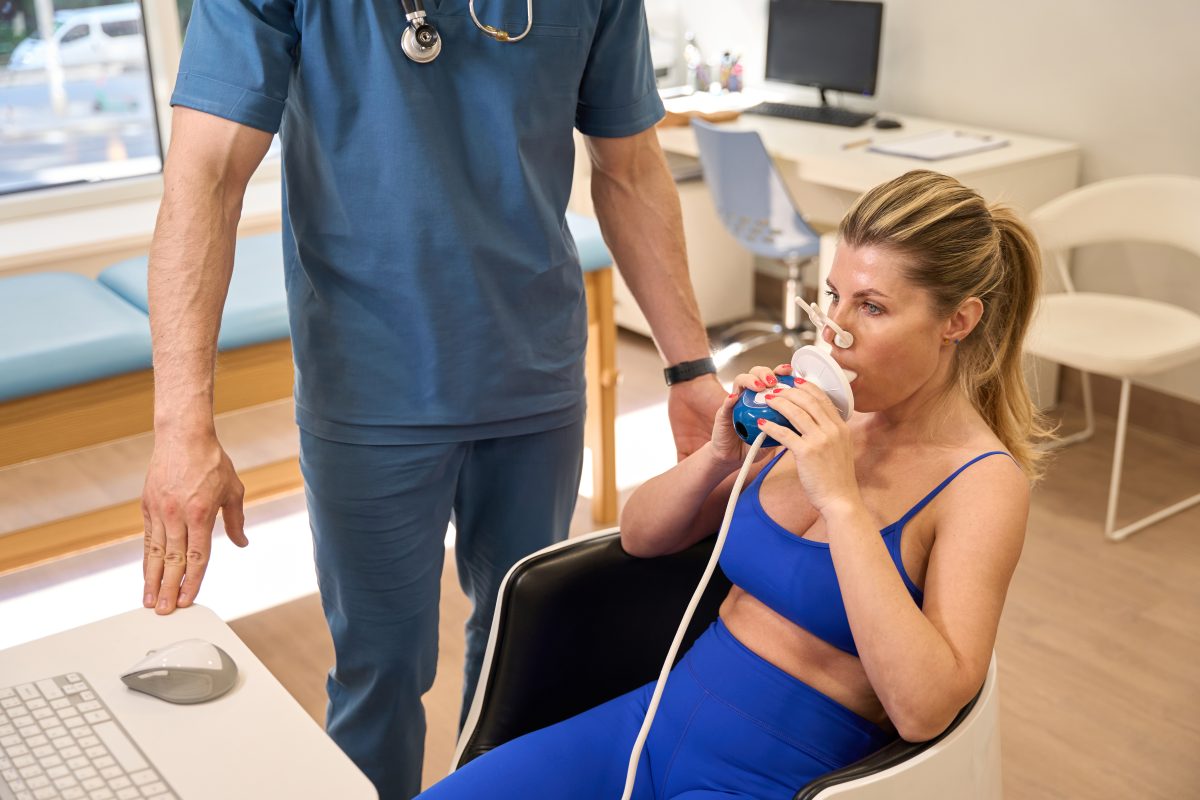
These are the most accurate methods for measuring VO2 max. They involve exercising at increasing difficulty levels while breathing into a mask that measures oxygen consumption and carbon dioxide production.
This setup allows for precise measurement of the point at which oxygen consumption reaches its maximum.
- Advantages: High accuracy and detailed data.
- Limitations: It is costly, requires specialized equipment and trained personnel, and is not suitable for all populations due to the required exercise intensity.
2. Field tests
Cooper test
It involves running as far as possible within 12 minutes. The distance covered is then used in a formula to estimate VO2 max.
Beep test
Requires running back and forth on a 20-meter track in time with audio beeps that increase in frequency every minute.
- Advantages: Can be conducted almost anywhere with minimal equipment.
- Limitations: Less accurate than laboratory tests and can be influenced by external factors like weather, surface, and individual effort level.
3. Wearable technology and mobile apps
Modern wearables and apps estimate VO2 max by analyzing heart rate data and physical activity over time.
- Advantages: Convenient and provides a reasonable estimate that helps track changes over time.
- Limitations: Less accurate than direct measurement methods, dependent on the quality of the algorithm and sensors.

How do you prepare for a VO2 max test?
Proper preparation is crucial to ensuring the most accurate results. Heavy meals, caffeine, and alcohol should be avoided 12 to 24 hours before testing [2].
Adequate sleep the night before and proper hydration can also significantly impact performance.
Lastly, familiarize yourself with the test procedures to help reduce anxiety and produce a more accurate measurement of your true VO2 max.
What factors affect your VO2 max?
Several factors influence VO2 max, affecting how much oxygen your body can utilize during intense exercise [3]. Understanding these variables can help you make informed decisions about improving your cardiovascular fitness.
1. Age
VO2 max generally peaks in early adulthood and gradually declines as you age, primarily due to the natural decrease in cardiovascular and muscle function.
2. Gender
On average, men tend to have higher VO2 max levels than women due to differences in muscle mass, lung capacity, and hemoglobin levels. However, fitness training can significantly narrow this gap.
3. Genetics
Your genetic makeup plays a significant role in determining your natural VO2 max potential. Some people are predisposed to have a higher VO2 max, though training can still lead to substantial improvements.
4. Fitness level
Aerobic exercise, particularly endurance training, can significantly improve VO2 max over time. Athletes who consistently engage in high-intensity workouts tend to have higher VO2 max levels than sedentary individuals.
5. Altitude
Training at higher altitudes can temporarily increase VO2 max by improving the body’s efficiency in oxygen utilization, though the effect diminishes once at lower altitudes.
6. Health status
Conditions like cardiovascular or respiratory diseases can negatively impact VO2 max, while improving general health through diet and exercise can lead to improvements.
How do you improve your VO2 max?
Improving your VO2 max is a practical way to boost cardiovascular health and enhance athletic performance. Here are some targeted strategies to effectively increase your aerobic capacity:
1. Aerobic exercises
Regular aerobic activities like running, cycling, and swimming are among the best ways to improve VO2 max. These exercises increase heart rate, promote oxygen circulation, and build endurance.
Start with moderate-intensity sessions, gradually increasing the duration and intensity to challenge your cardiovascular system [4].
2. High-Intensity Interval Training (HIIT)
HIIT is a highly effective method to boost VO2 max in less time [5]. It involves alternating between short bursts of intense exercise and rest or low-activity periods.
This type of training pushes your heart and lungs to work harder, increasing your oxygen uptake capacity. Incorporating HIIT sessions 2-3 times a week can lead to measurable improvements in VO2 max.
3. Strength training
While aerobic workouts are key, strength training also plays a role in enhancing cardiovascular capacity.
Exercises that engage large muscle groups—like squats, lunges, and deadlifts—can improve overall endurance and help your muscles use oxygen more efficiently.
4. Nutrition and supplements
Proper nutrition supports your training efforts. Ensuring adequate intake of carbohydrates, proteins, and fats provides the energy needed for high-intensity workouts.
Supplements like beetroot juice (high in nitrates), caffeine, and omega-3 fatty acids may also support better oxygen utilization and endurance during exercise.
What is an ideal VO2 max?
An ideal VO2 max varies depending on factors like age, fitness level, and the specific demands of different sports. Here’s what to consider when determining what an ideal VO2 max might look like for you:
1. Age groups
VO2 max naturally declines with age, so what’s considered ideal shifts over time. For younger adults (ages 20-29), a VO2 max between 40-50 ml/kg/min is typically considered good for men, while 30-40 ml/kg/min is typical for women.
These numbers drop slightly by the time people reach their 50s and 60s, but maintaining fitness can help slow this decline.
Here’s a table showing the ideal VO2 max values for men and women across different age groups [6]:
| Age group | Men – Excellent (ml/kg/min) | Men – Good (ml/kg/min) | Women – Excellent (ml/kg/min) | Women – Good (ml/kg/min) |
|---|---|---|---|---|
| 20-29 | 46.5-52.4 | 42.5-46.4 | 37.0-41.0 | 33.0-36.9 |
| 30-39 | 45.0-49.4 | 41.0-44.9 | 35.7-40.0 | 31.5-35.6 |
| 40-49 | 43.8-48.0 | 39.0-43.7 | 32.9-36.9 | 29.0-32.8 |
| 50-59 | 41.0-45.3 | 35.8-40.9 | 31.5-35.7 | 27.0-31.4 |
| 60+ | 36.5-44.2 | 32.3-36.4 | 30.3-31.4 | 24.5-30.2 |
2. Fitness levels
Fitness level plays a significant role in determining an ideal VO2 max. Sedentary individuals tend to have lower VO2 max values, but even moderate exercise can yield improvements.
Recreational athletes may aim for values between 50 and 60 ml/kg/min, while elite athletes, particularly in endurance sports, can have VO2 max levels exceeding 70 ml/kg/min.
3. Sports disciplines
Different sports place varying demands on aerobic capacity, affecting what’s ideal for specific disciplines.
Endurance athletes, like long-distance runners or cyclists, typically have higher VO2 max levels.
In contrast, athletes in sports involving short bursts of energy, like sprinters or weightlifters, may have lower VO2 max levels but still perform optimally.
How do you calculate your VO2 max at home?
To calculate your VO2 max at home without specialized equipment, you can use established formulas and tests designed to approximate this measurement based on field performance. Here’s a practical approach using the Cooper Test, a popular method:
Cooper test for estimating VO2 max
This test requires a flat surface where you can run continuously for 12 minutes. Here’s how to proceed:
1. Warm up. Begin with a light warm-up consisting of stretching and a few minutes of jogging to get your heart rate up without exhausting yourself.
2. Run as far as possible on a track or measured path for 12 minutes. Try to maintain the fastest pace you can sustain for the entire duration.
3. Record the total distance you covered in meters.
4. Calculate VO2 max. Use the following formula to estimate your VO2 max:

This formula is derived from the original Cooper Test research, providing a close estimate based on your running performance.
Tips for accuracy
- Use a stopwatch to time your 12-minute run accurately.
- If possible, run on a track or a pre-measured path to ensure the distance is accurate.
- Try to keep a steady, sustainable pace rather than starting too quickly and slowing down significantly.
How often should VO2 max be tested?
The frequency of VO2 max testing depends on your fitness goals, training intensity, and changes in your workout regimen.
As a general guideline, testing your VO2 max every 6 to 12 weeks can provide useful feedback on your cardiovascular fitness improvements and the effectiveness of your training program.
More frequent testing—perhaps every 3 to 4 months—can benefit athletes or individuals engaged in serious training.
This schedule allows adjustments to be made in response to training adaptations, ensuring that workouts remain appropriately challenging and targeted toward specific fitness goals.
Testing every six months to a year may be sufficient for recreational exercisers or those new to fitness. This frequency helps track general health and fitness trends without requiring frequent assessment.
Regardless of the testing frequency, it’s important to maintain consistency in the conditions under which you test.
This includes using the same test method, similar environmental conditions, and, ideally, testing at the same time of day.
Consistent testing conditions help ensure the results are reliable and can be accurately compared over time.
How do you monitor and maintain your VO2 max?
Maintaining and monitoring your VO2 max is crucial for fitness and health, especially as you age or adjust your training routines. Here’s how you can keep your VO2 max at its best:
1. Engage in regular exercise
Consistency is key. Regular aerobic and strength training exercises to maintain cardiovascular health and muscle efficiency.
As you age, adjust your exercise intensity and duration to match your fitness level and health needs, ensuring you continue challenging your cardiovascular system safely.
2. Get assessed periodically
Regularly measuring your VO2 max can provide insights into your cardiovascular fitness and help you adjust your training plans.
Re-assessing your VO2 max every few months or after significant changes in your training regimen or lifestyle can help you track whether you are improving, maintaining, or modifying your approach.
3. Use technology and tools
Various tools can help track and estimate VO2 max, making it easier to monitor changes over time. Wearable fitness trackers and smartwatches often include features to estimate VO2 max based on heart rate and activity levels.
Consider using apps or devices specifically designed for VO2 max testing that utilize breath-by-breath analysis during exercise for more accurate measurements.
Closing thoughts
Understanding and measuring your VO2 max offers valuable insights into your cardiovascular health and aerobic capacity.
Using methods like the Cooper Test or wearable devices, you can effectively estimate your VO2 max at home and track your fitness progress.
Regular testing, adjusted according to training intensity and goals, helps refine workouts and boost performance.
Embrace these strategies to enhance your aerobic fitness, ensuring that each step is informed by reliable data and tailored to meet your personal health and fitness objectives.
FAQs
Does VO2 max change daily?
VO2 max does not change daily; it reflects your cardiovascular fitness over longer periods. Consistent training and recovery are needed to see changes.
What foods increase VO2 max?
Foods rich in nitrates, such as beets and leafy greens, can help increase VO2 max by improving oxygen efficiency in the body. Antioxidant-rich foods like berries also support better oxygen flow.
How fast can you improve VO2 max?
Regular, intensive aerobic exercise can improve your VO2 max within a few weeks. However, significant improvements often require consistent training over several months.
Why is my VO2 max so low?
A low VO2 max can be due to inadequate physical activity, aging, or underlying health conditions. Improving fitness levels and addressing any medical issues can help raise it.
[1] Physiologically Speaking. Is VO2 Max the Best Measure of Fitness and Performance?
[2] National Sports Medicine Institute Sports Science. VO2 Max Pretesting Guidelines
[3] Wiley Experimental Physiology. Biological and methodological factors affecting V̇O2 max response variability to endurance training and the influence of exercise intensity prescription
[4] Medicine & Science in Sports & Exercise. Aerobic High-Intensity Intervals Improve VO2max More Than Moderate Training
[5] Journal of Science and Medicine in Sport. Effects of different protocols of high intensity interval training for VO2max improvements in adults: A meta-analysis of randomised controlled trials
[6] Verywellfit. VO2 Max Testing

