
Booster Therapeutics founder says treating complex diseases requires targeting and degrading multiple toxic proteins at the same time.
The recent launch of Berlin-based Booster Therapeutics has once again highlighted the therapeutic potential of harnessing the body’s natural ability to degrade harmful proteins. The proteasome has long been recognized for its therapeutic potential due to its role in breaking down damaged or “misfolded” proteins to preserve cellular health. While traditional drug development approaches have sought to inhibit disease-causing proteins, the proteasome degrades them, offering the potential to achieve more effective responses at lower doses – and with fewer side effects.
The first generation of targeted protein degradation drugs are already showing great promise in the treatment of cancer, but Booster is betting that targeting the proteasome holds the potential for treatment of a much wider range of complex, chronic conditions.
Longevity.Technology: As we age, or become ill, our proteasome function declines, leading to the accumulation of toxic, misfolded proteins that contribute to neurodegenerative and other complex conditions. Booster is developing small molecule therapeutics designed to target these dysfunctions, providing the “boost” needed to restore the proteasome to full power. To learn more about the company’s approach, we caught up with its co-founder and CSO, Dr Diogo Feleciano.
Along with his scientific co-founder, UC Irvine Professor Darci Trader, Feleciano has conducted extensive research into harnessing the potential of the proteasome to stimulate and direct protein degradation. There are two key proteasomes in our cells, known as 26S and 20S, but most targeted protein degrader drug development to date has focused on 26S.

“Typically, targeted protein degradation approaches go after one protein – they enforce the system to put a ubiquitin tag on that protein, and that ubiquitin tag will make that protein recognizable by the 26S proteasome, which then degrades it,” explains Feleciano. “This is a fantastic technology, lots of companies have been created and many billions of dollars have been invested in this space.”
Degrade all misfolded proteins at once
While effective for diseases caused by single protein dysfunctions, the targeted degradation approach may not be as effective for conditions involving multiple protein abnormalities, such as neurodegenerative diseases. Booster is instead focusing on the potential of the 20S proteasome, which is capable of targeting multiple misfolded proteins simultaneously.
“What sets us apart is that we are pioneering a new field of protein degradation, where we aim to reduce not just one misfolded protein but all the misfolded proteins in a cell, with a single drug,” says Feleciano. “The 20S proteasome allows us to do this because it only degrades damaged, toxic, misfolded proteins, which is already a differentiated type of degradation from the 26S, which degrades fully folded proteins.”
In addition, Feleciano explains that the 20S proteasome doesn’t require ubiquitin tagging to identify misfolded proteins.
“It just does it naturally, and it’s quite effective,” he says. “What’s is also interesting is that, unlike the 26S proteasome, the 20S doesn’t consume ATP [cellular energy] to work, which is quite interesting in an aging context, where you want to preserve energetic consumption.”
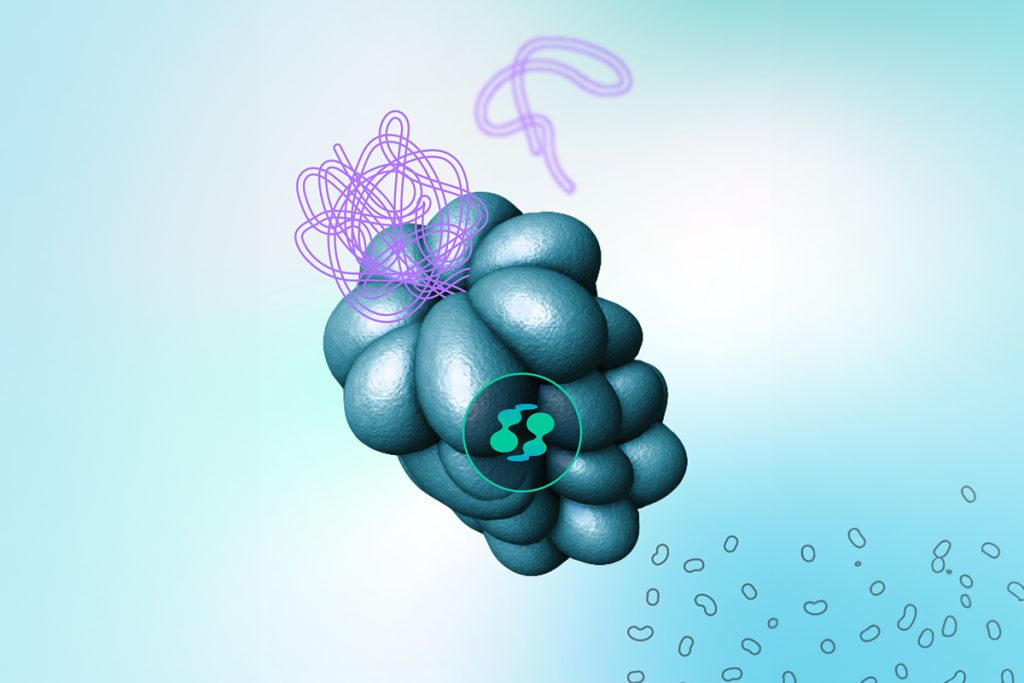
The ultimate goal of reducing the number of misfolded proteins in a cell is to decrease the toxicity that these toxic proteins are all creating overall, and putting the cell in a healthier state. Feleciano says that Booster has already validated these effects in its preclinical work, demonstrating that its compounds rebalance cellular health and homeostasis.
“This is exactly what we’ve been seeing with our molecules in the lab,” he says. “We can achieve these outcomes in different disease models, and this gives us the confidence that we are in the right mode of action to really modulate the pathology and have the efficacy that will be meaningful in the end for the patients.”
Multi-indication potential
Using neurodegeneration as an example, Feleciano explains why Booster’s approach may have the potential to succeed in diseases where others have failed.
“So far, conditions like Parkinson’s and Alzheimer’s have been very resistant to single, targeted approaches,” he says. “If you only focus on one piece of the puzzle, the efficacy is low or non-existent. But we know that there is proteasome dysfunction in neurodegeneration, and multiple pathways are going wrong, so we are exploring a single, broad-spectrum type of approach of proteasome activation for these complex, hard-to-treat indications.”
Beyond neurodegeneration, the potential applications of the Booster’s approach extends into a range of other disease areas, and Feleciano also mentions cardiometabolic diseases as a potential avenue for the company.
“We don’t want to be a single disease company – we aim to build a multi-indication pipeline,” he says. “There are different areas in the body where we would like to have an effect, and we are lucky that our target is present in all cells.”
Multiple molecules identified
With the 20S proteasome clearly holding so much potential for targeting complex diseases, it raises the question as to why 26S has been the favored target for drug development. In a nutshell, says Feleciano – it’s not easy.
“An understanding of the biology itself is probably the crucial aspect – you need to understand deeply how all this works to inform how to build a platform to find these molecules,” he says. “It’s really difficult to find these activation molecules and requires high level of specialized techniques to screen for these molecules and also to develop them.”
To overcome all these challenges, Booster developed its proprietary DGRADX platform, which combines automated high-throughput screening with advanced structural and computational tools.
“Our platform gives us the ability to discover and optimize molecules that activate the 20S proteasome,” says Feleciano. “We leverage automation to increase the speed and accuracy of our platform, and have incorporated advanced structural biology tools to look at the structure of our target – today we have the best proteasome structure ever solved. If we can build high quality data, then hopefully this translates into high quality drugs.”
Having started its work in 2020, Feleciano says that Booster has already identified multiple proteasome activators molecules with “favorable drug-like profiles” and compelling data around them.
“The data that we have in hand proves that we can find these molecules, and we can optimize them in a way that we can restore proteasome activity,” he adds. “This leads to the reduction of multiple toxic proteins in the same location, and rebalances overall cellular homeostasis and proteostasis within the cell. All of this has positive outcomes in different disease models, and we are hoping to initiate IND-enabling studies within a couple of years.”

