
Nucleus lands $14m for AI-powered consumer health platform that provides genetic risk assessments for more than 800 conditions.
Consumer health startup Nucleus has closed a $14 million Series A funding round supporting its “real-time quantified health platform” based on clinical-grade whole-genome DNA analysis. By providing accurate risk assessments for more than 800 conditions, including cancers, heart disease and Alzheimer’s, the company aims to give people the information they need to take action around their long-term health – all for just $399.
The funding round, which brings the total raised by Nucleus to nearly $32 million, was backed by existing investors, including Reddit founder Alexis Ohanian’s Seven Seven Six and Peter Thiel’s Founders Fund, as well as new investments from Neo, Giant Step Capital, One Eight Capital, Balaji Srinivasan and Achal Upadhyaya.
“The next trillion dollar business is going to be in consumer health,” said Ohanian, who has invested more than $10 million in Nucleus through his VC arm. “In today’s healthcare climate, there’s no one else on the market who has built a future-focused, patient-first solution of this caliber.”
Targeting a perceived gap in consumers’ understanding about how their health data interact, Nucleus aims to contextualize each data point with DNA to provide a more complete picture of health.
Longevity.Technology: The cost of sequencing the first full human genome was around $3 billion, but today a whole-genome test can be completed for just a few hundred dollars. It was this realization that inspired Nucleus founder Kian Sadeghi to drop out of university and build a company to harness the genome to generate consumer health insights – at an affordable cost. We caught up with Sadeghi to find out more about the company’s approach.
Initially inspired to study computational biology after the loss of his cousin who died of a rare genetic disease, Sadeghi’s made the decision to start a company after learning about the decreasing cost of reading all of someone’s DNA in genetics class.
“I realized the price was obviously going towards zero and everyone was going to be able to get their genome sequenced,” he recalls. “Which meant that someone needs to build the application layer for DNA. So why don’t I give it a shot?”
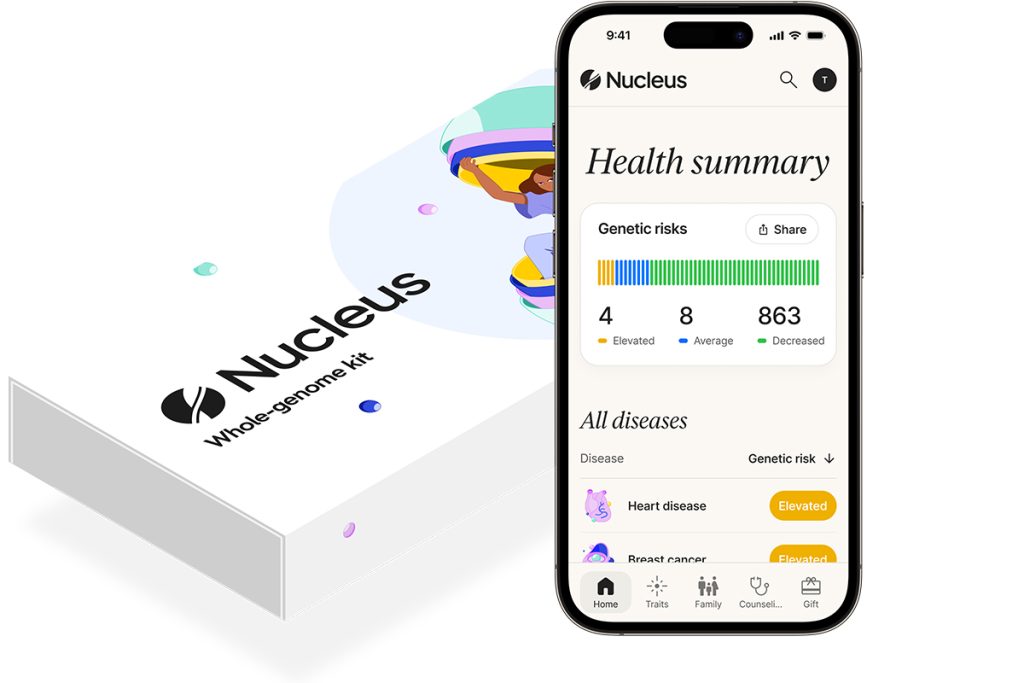
Building DNA’s ‘application layer’
This led Sadeghi to create Nucleus, a consumer-focused health company offering an accessible clinical grade whole genome health test. But the test itself isn’t the most interesting part of what the company does. As ever, it’s what you do with it that counts.
“Nucleus is really the application layer – we build models or algorithms that analyze DNA,” says Sadeghi. “We’re a software company, principally, and that lets us have an offering that can be more accessible to people. The reason we can keep costs down is because we basically build systems that makes this process super-efficient, and we do it at a scale that no one else really does.”
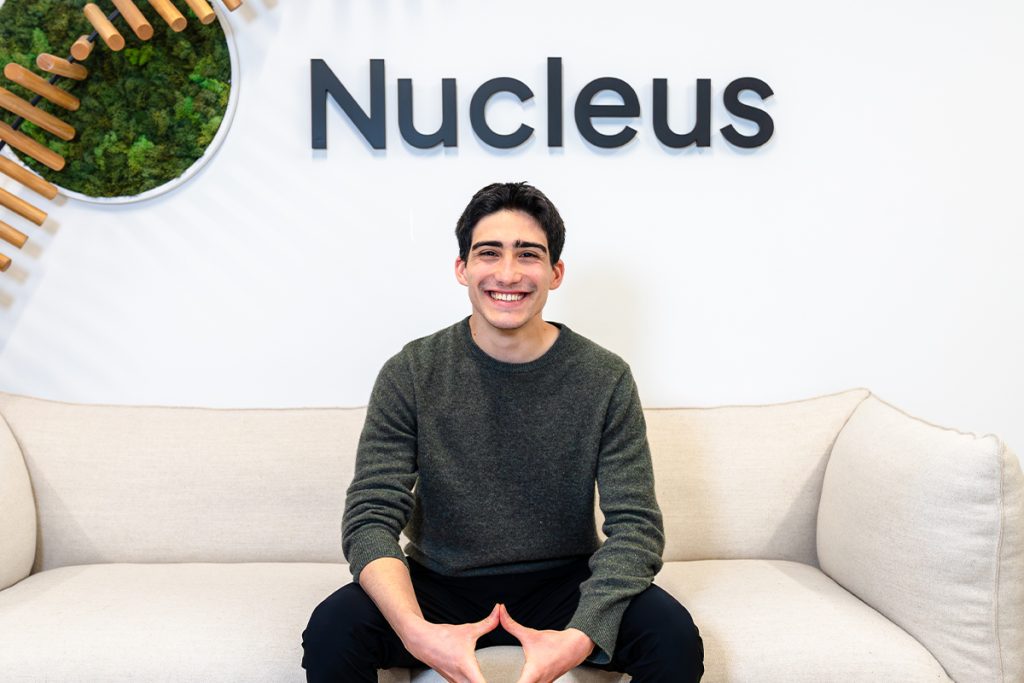
“First, we look at a number of key genes across many common and rare conditions, I think it’s around 800 to 1000 at this point, and we look for really bad markers. Then we combine up to a million markers that are actually in non-genetic regions into polygenic scores.
“Finally, in addition to your entire genome, we also factor in things like your BMI, your sex, your age, your cholesterol, your A1C, into an integrated health platform so that you can see how your genetics combines with your other non-genetic information to calculate your overall risk of getting conditions.”
Sadeghi claims there are currently more than 70,000 different genetic tests out there, all looking at different areas of DNA for different conditions. However, he says it’s now possible, and cost-effective, to read the whole genome and conduct an analysis of thousands of conditions in a single test.
“You can take all those tests, put them in a single swab, and give someone their genetic health blueprint – the source code, if you will,” says Sadeghi. “All these applications used to require different genetic tests, but we combine all those tests into just one. And the beauty of genomics is that once you have someone’s whole genome, that genome is not changing, and so you can continually analyze the DNA and give people more and more and more insights over time.”
To illustrate his point, Sadeghi explains that when Nucleus launched around 9 months ago, the company was only reporting on around 10 conditions.
“Today we have over 800 so that shows just how quickly and rapidly we’ve been expanding the product,” he says, explaining that customers can sign up for a $39 a year subscription to get access to all the latest analyses.
“The best part about this is, genetics research is going to improve – we’re going to add more and more analyses, and various other cool features on top of that. And you don’t have to take another test, you don’t have to swab again. You do one test, one swab, and you get results for life – it’s the true realization of the Human Genome Project.”
Expanding product roadmap
Nucleus recently acquired Cambrean, an AI-driven health platform that transforms data from devices like Oura rings and Apple Watches into meaningful health assessments, and Sadeghi says the new funding will enable the integration of this technology to introduce new features.
Among these is a natural language tool that will allow users to explore and monitor their layered health data, starting from their genetic foundation. By analyzing this information, Nucleus will offer tailored diet, exercise and diagnostic protocols, shifting from problem identification to actionable health solutions.
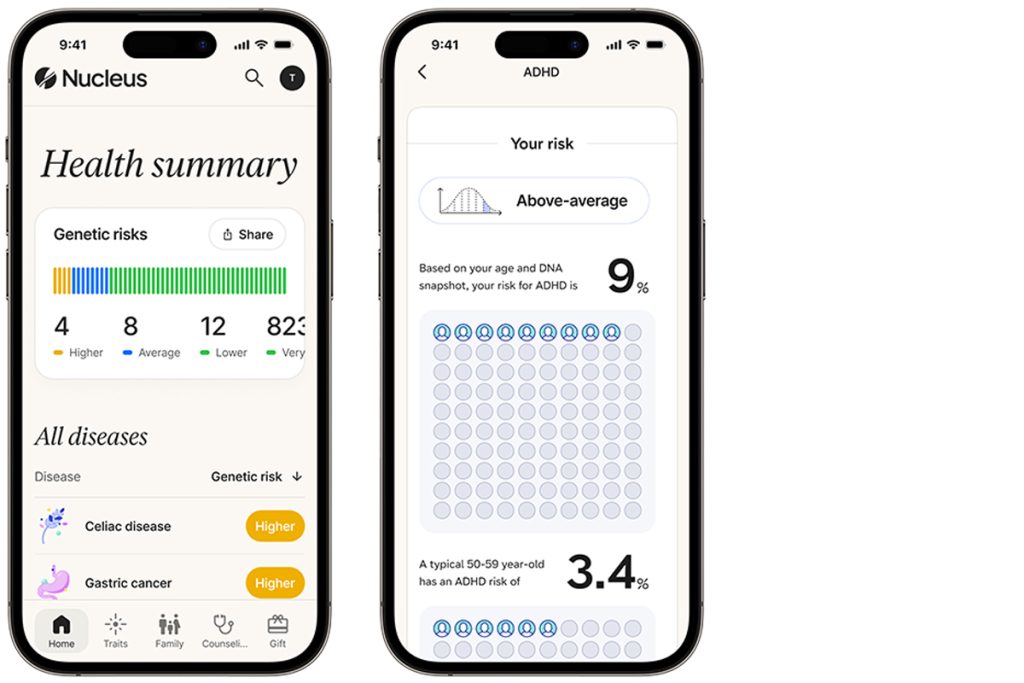
“This is very important, because a lot of companies are interested in just bringing data together from various different diagnostic tests,” says Sadeghi. “But that’s actually not what people want. What they really want is insight – to understand how these datapoints interact. And then how certain actions, certain behaviors, affect their risk.”
Nucleus is also expanding into pharmacogenomics, addressing the fact that most people have genetic variants affecting their response to medications. Without requiring additional testing, the company will provide users with insights into how their DNA influences their reaction to drugs, including blood thinners, antidepressants, and cancer treatments.
Additionally, the company aims to make genetic family planning more accessible through a “Family Forecast” feature, a form of testing has typically been available only through costly, physician-ordered screenings.
Data privacy is key
While Sadeghi doesn’t reveal how many customers Nucleus currently has, he does drop some hints.
“What I can say is, we’re scaling very quickly,” he says. “If you look at the largest whole genome database in the world, it’s around half a million people, and I think we’ll be able to beat that in just a couple of years.”
So how does Nucleus intend to make use of this growing resource of genetic data?
“Today, people often conflate consumer genetics with bad security practices and little control of their data,” says Sadeghi. “For me, this is so tragic because there are life-saving insights hidden in everyone’s DNA, and there are already existing frameworks to protect your health data – it’s just that first-generation genetics companies like 23andMe did not follow them.”
“When you go to the doctor’s office or a hospital, for example, you can solely focus on getting better care because you know there are regulations that protect you and give you control over your health,” he adds. “I wanted Nucleus to be the same. That’s why we’re a medical provider. This means we’re bound by the same privacy laws as your doctor or hospital, so your data is used only to provide you with better care. Part of this stringent approach means we never share user data unless they want us to – no tricks or gimmicks – and choose to follow the strictest privacy practices.”

