
Singapore event set to bring together global experts to explore the role of physics in longevity science.
The first Global Conference on Gerophysics will take place on the 5th and 6th of March at the National University of Singapore; chaired by Brian Kennedy, Jan Gruber and Max Unfried, the event aims to formalize gerophysics as a new sub-discipline within longevity research. With an expected attendance of 150–200 participants from around the world, the conference marks a renewed effort to integrate theoretical physics and complex systems science into the study of aging – and Longevity.Technology is proud to be a media sponsor.
“Geroscience is currently lacking reliable quantitative models that explain the underlying phenomena of aging,” Max Unfried told Longevity.Technology.

“Without strong theoretical frameworks most experiments resemble random trial and error. Quantitative approaches from theoretical physics and complex systems science can help to develop stronger frameworks that can be experimentally tested, moving the field forward one hypothesis at a time. Hence, the goal is to get 500 physicists thinking about the biology of aging in the next 5 years and built a vibrant science community.”
As our readers might expect, Dr Peter Fedichev, Director and Cofounder of Gero.ai is one of the speakers at the conference.
“The inaugural Gerophysics Conference in Singapore marks a significant moment where we bridge the gap between physics and biology,” he told us. “This convergence is not just academic; there are more and more hints that it may be pivotal for advancing our understanding of aging at a fundamental level. We’re at the cusp of translating complex theories into tangible healthspan extensions.”
Longevity.Technology: Mathematical models in aging biology have largely been constrained to linear approaches; while these models can describe trends, they fall short of explaining the fundamental principles driving aging. Recent advances in AI have introduced more sophisticated analytical methods, yet many AI models function as ‘black boxes’ – capable of making predictions but offering little interpretability.
Theoretical physics, by contrast, provides a framework for understanding complex systems in a quantitative and mechanistic way. The field has a long history of transforming scientific disciplines – from quantum mechanics reshaping chemistry to statistical physics revolutionizing epidemiology. A similar shift could occur in aging research if physicists are encouraged to contribute their methodologies; the key challenge is creating an environment where interdisciplinary research is not only possible but actively supported.
Physics and aging: A historical disconnect
The application of physics to aging research has a (sadly) limited history; Strehler and Mildvan published their General theory of mortality and aging back in 1960, a paper that offered an early theoretical approach to the problem. Since then, geroscience has progressed rapidly – focusing on biological and genetic interventions – while physics has remained largely peripheral to the field. The upcoming conference seeks to address this imbalance, proposing that aging should not only be studied as a biological process but also as a question of physics.
Aging is more than a series of biological processes; everything is composed of atoms joined together by ionic bonds, and a more fundamental view, a ‘back to basics’ approach, is one the late Dr Leonard Hayflick encouraged researchers to adopt when we spoke to him in 2022.
“The reason that life exists is because of the constraint of chemical bonds that hold molecules together,” he told Longevity.Technology. “But those bonds are energy bonds and, in time, the energy in those bonds is going to escape, which is what the second law describes will happen. Eventually we are going to die because the energy in some set of biomolecules in our bodies is going to dissipate, including those in the repair processes that once worked, but now don’t, because they suffer the same consequences of the second law as do their substrate biomolecules. So, aging is a problem in physics and not in biology.”
Viewing aging as not just as a biological decline but as a fundamental consequence of physical laws is an idea that aligns with Dr Peter Fedichev’s outlook.
“Understanding aging through the lens of physics offers us a unique perspective on biological processes,” Fedichev told Longevity.Technology.
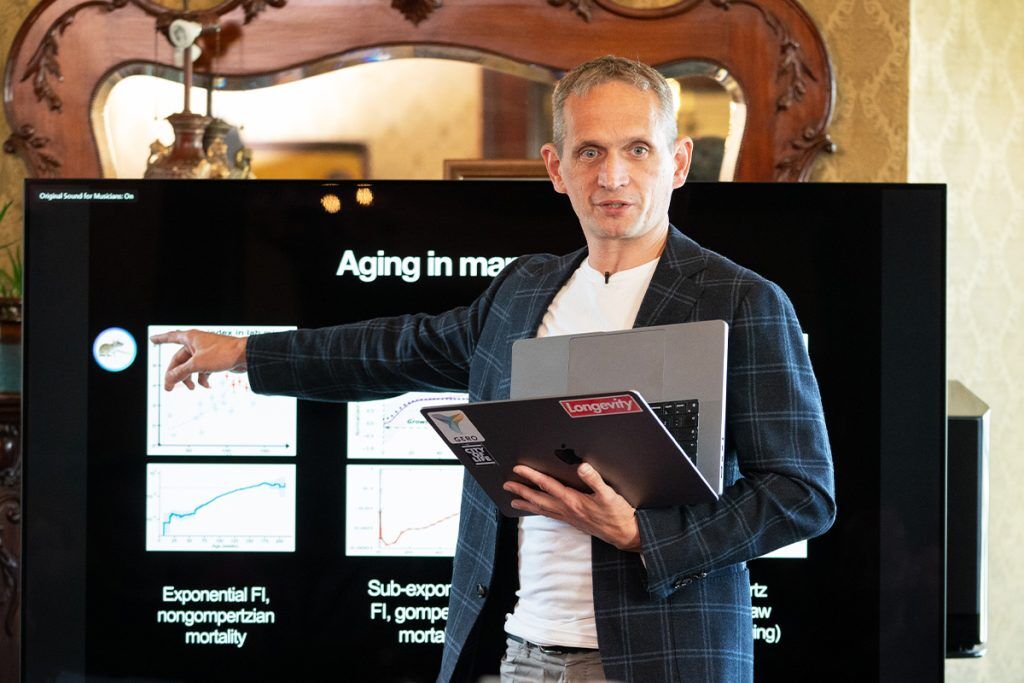
“Physics provides the best tools to quantify the entropy and resilience of biological systems, which are central to comprehending why and how we age. This conference is where we’ll explore how these physical principles can inform and possibly revolutionize geroscience.”
The promise of complex systems science
Physicists are trained to develop quantitative frameworks capable of describing complex systems; the mathematics of physics has been widely applied in other domains, from climate science to neuroscience. However, aging research has predominantly relied on statistical models and AI, which, while powerful, often provide correlation rather than causal understanding. By incorporating methodologies from theoretical physics, researchers aim to gain deeper insights into the underlying mechanisms of aging across multiple biological scales.
Aging is a multifaceted phenomenon, involving interactions at the molecular, cellular and organismal levels; understanding these interactions requires tools that can model complexity beyond simple linear regressions, and theoretical physics offers a robust toolkit to address such challenges, particularly in areas like thermodynamics, statistical mechanics and dynamical systems theory.
The role of entropy in aging is one such avenue of exploration; several recent discussions have examined whether aging can be understood as an entropic process – a gradual loss of order within biological systems driven by the second law of thermodynamics. Applying physics-based models to longevity research may help clarify how energy dissipation, molecular damage and system-wide degradation contribute to aging and lifespan determination.
Challenges in integrating physics into geroscience
Despite the potential benefits, integrating physics into longevity research presents logistical and conceptual challenges. The field of aging biology has primarily been shaped by life scientists; few researchers have formal training in physics or mathematical modeling beyond traditional statistical approaches, and as a result, there is a lack of physicists working within aging research, making it difficult to secure peer reviewers with expertise in both disciplines.
The conference in Singapore represents a critical step in addressing this issue; by bringing physicists and aging researchers into direct dialogue, it aims to foster collaborations and encourage physicists to apply their expertise to longevity science. The establishment of gerophysics as a recognized field could also create academic pathways for training researchers with interdisciplinary skills, bridging the existing gap between biological and physical sciences.
Towards a physics-based paradigm in longevity science
By convening experts from physics, biology and longevity science, the upcoming conference at the National University of Singapore aims to establish gerophysics as a structured research area. The event will address fundamental questions, including how principles from physics can be applied to understand biological aging, how to develop quantitative aging models beyond traditional statistical approaches, and how to facilitate interdisciplinary collaboration.
“Physics gives us the framework to measure and model the dynamics of aging processes. By looking at how energy is managed, how entropy increases, and how biological systems maintain order, we can develop strategies to mitigate aging’s effects,” Fedichev says. “This conference will explore how these physical concepts can be applied to enhance our biological research, potentially leading to breakthroughs in longevity biotechnology
As longevity research continues to expand, integrating physics-based methodologies could provide novel insights into aging mechanisms – potentially offering new pathways for intervention. The conference represents an early but significant step in building a physics-informed approach to aging, laying the groundwork for future collaborations and research directions.
The Global Conference on Gerophysics will be held on 5th & 6th March at the National University of Singapore – CLICK HERE for more information.

