
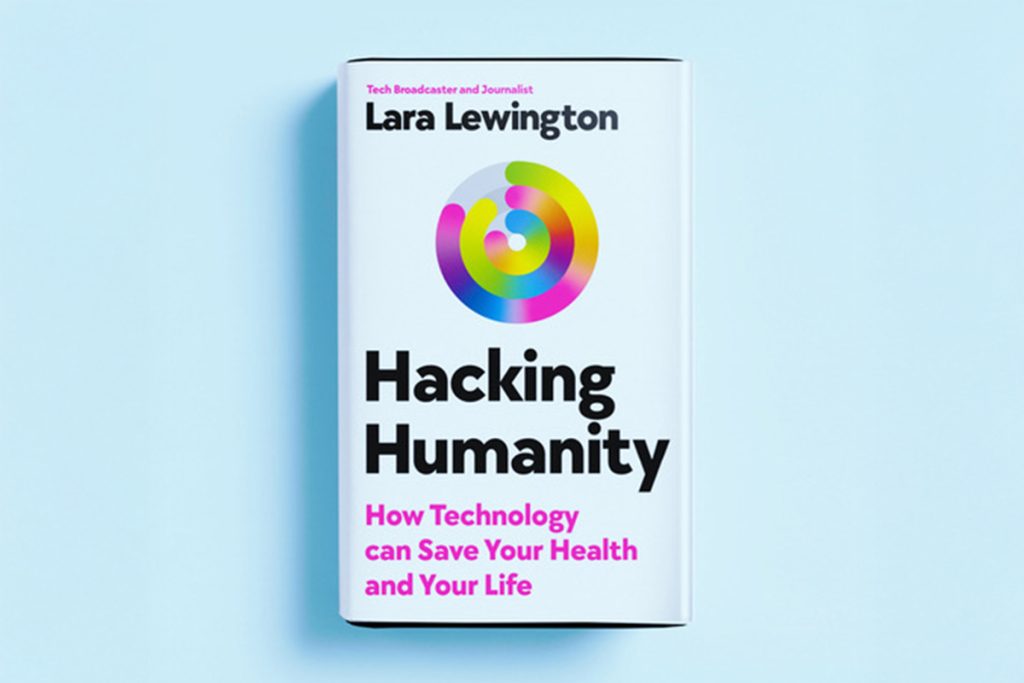
Lara Lewington’s new book Hacking Humanity explores the tech shaping tomorrow’s healthcare – and what it means for our future healthspan.
Lara Lewington has long been a trusted translator of tech – taking innovations that risk becoming opaque to all but the initiated and rendering them not only comprehensible but compelling. In Hacking Humanity, which is published today, Lewington turns her attention to the rapidly converging domains of AI, gene editing, robotics and preventive health, asking what it really means to live well – and longer – in a world where scientific advancement increasingly promises both. Part investigation, part personal journey, the book is a measured yet accessible tour of the technologies shaping the future of medicine; one that doesn’t so much chase immortality as question how we might better inhabit the years we already have – and those that might soon be on offer.
Longevity.Technology: Lewington’s Hacking Humanity adeptly navigates the intricate terrain of emerging health technologies, distilling complex scientific advancements into narratives that resonate beyond the confines of the laboratory. By intertwining personal experimentation with expert insights, she bridges the often daunting gap between cutting-edge research and everyday understanding. In doing so, Lewington doesn’t merely inform; she invites readers to engage critically with the ethical, societal and personal implications of our accelerating quest for extended healthspan. It’s a timely contribution that challenges us to consider not just the possibilities of living longer, but the responsibilities that come with it. We sat down with her to find out more about her experiences and the book that came out of them.
Lara Lewington on…
Technology as a tool, not a threat
Technology isn’t the enemy. Technology invites a lot of possibility and promise and we just need to know how to embrace that best. This is such an important story, and it’s something that people really need to understand. I wanted to really get into the nitty gritty of what the concept of increasing healthspan, not just lifespan, actually means. People are feeling 60 at 40. Right now in England, women are spending 25% of their lives in poor health, men 20%. That’s in a high-income country; that’s not right, and we need to do something about it. And actually, technology is offering us many solutions. So I just wanted to tell that story. And there’s only so much you can fit into a TV or radio program – a book can be a lot longer.
AI at the core of the longevity revolution
There are so many technical innovations and longevity techniques, and it’s actually the combination of all of them which is really the power. Artificial intelligence allows us to be able to collect genetic data, lifestyle data, data on our activity, disease incidence, &c, and make findings that no human ever could. The power of AI is absolutely massive. It has the ability to be an extra pair of eyes on scans, to crunch all sorts of data to work in drug discovery. We might know what lifestyle changes we need to make, but now we are able to quantify our lifestyle better. For example, we can find out how air quality affects our sleep – and that’s localized air data – in the house, not just within the area. Data like this will absolutely transform what we know about ourselves and what we know about disease.
Balancing privacy with progress
The balance over concern versus benefit for all forms of AI and all forms of technology are important conversations to have. There are very real risks, there are very real benefits, and we need to figure out the trade-offs and the best and safest way of approaching everything. A lot of the benefit that’s gleaned from data is through anonymized data. And it’s really important to understand what we do at a society level with all the data we’re collecting. As over the years, we start to add more social data, more information on lifestyle, where we are, our location, things that could make us more identifiable, we have to make sure that data doesn’t become de-anonymized. So there are certainly risks with this and it’s important to be cognizant of them. But at the same time, we don’t want to not be giving our data in instances where it’s safe and it could transform our knowledge of our health. Because there’s a lot that we can learn through collecting at population level, but there’s also a lot of individual personalized feedback you can get on your own data, how medicines are going to work on you, and so on, in future.
Actionable data, not dystopian forecasts
We need to be sensitive to that fact that long term we are looking at an absolute transformation – we’re going to be able to diagnose cancers earlier, even predict better who we should be screening. An earlier diagnosis means better, kinder treatment, and then there’ll be the personalization of treatment. There is incredible progress to come, but sadly, it’s not happening overnight. Biological age data is going to become increasingly useful and it’s about the bits that are actionable – we don’t want to know that we’re going to die at 50 if there’s nothing we can do about it. We want to know the things that we can change and make a difference to.
Longevity you can live with
The first time I filmed with Bryan Johnson, I left feeling terribly guilty about every bad thing I’d ever done in my life! I lead a healthy life. It’s not extreme, and I wouldn’t say I’ve changed it that much; this is what we can do for lifestyle – we need to do things that we can stick to. And the problem with a lot of fad diets and lot of trends is that people do things briefly. I live pretty healthily, albeit not perfectly, and that works for me and I hope will continue to work. I don’t want to live to 200 – this isn’t about living to a grand old age – it’s about shortening that gap between healthspan and lifespan. The fact that I run 5K every day isn’t going to guarantee me anything, but it’s going to better my chances of being more healthy overall.
Hacking Humanity by Lara Lewington is published today and is available from all good booksellers or online HERE.

