
Last weekend was Halloween, and anyone who took their kids trick-or-treating or attended a Halloween party probably glimpsed a few familiar costumes—Freddy Krueger, Michael Myers, maybe a Scream or Saw mask here and there—but how many of you have ever seen someone dressed as an atherosclerotic plaque or a mass of cancerous cells? The latter will ultimately be the cause of death for most Americans, yet their constant, looming threat doesn’t carry quite the same gripping, terrible punch as murder or terrorism.
Of course, horror films are fiction. But according to a recent article from Our World in Data, this discrepancy in emotional impact drives more than just the entertainment industry. It also trickles into mainstream news outlets, skewing coverage toward the sensational and away from the threats that actually account for most deaths in the U.S.
A mismatch between mortality and media
The article, “Does the news reflect what we die from” takes an investigative look at how the media’s attention aligns with reality.1 The authors examined the twelve leading causes of death in the U.S. in 2023, then added homicide, drug overdoses, and terrorism—topics that often dominate headlines despite their relatively small toll. Together, these categories accounted for roughly 76% of all U.S. deaths that year. To see how media coverage stacked up against actual causes of death, they performed an automated keyword search across stories from major national outlets, including The New York Times, The Washington Post, and Fox News.
Perhaps unsurprisingly, media coverage gravitated toward rare but emotionally charged causes of death—terrorism, homicide, and drug overdoses—while giving little space to the conditions that claim the most lives, like heart disease, cancer, metabolic diseases, and neurodegenerative diseases (their ubiquity and high death toll is exactly why I call them the “four horsemen of chronic disease”). Heart disease and cancer alone accounted for 56% of deaths in the sample, yet together appeared in only about 7% of media stories on mortality. At The New York Times, for instance, heart disease made up just 2.8% of related coverage despite accounting for nearly a third of deaths. Similar gaps appeared across the three outlets studied. By contrast, homicide accounted for less than 1% of deaths in the sample but dominated 42–52% of media stories. Terrorism—responsible for only 16 deaths—recieved up to 18% of coverage. A single figure from the article drives the point home (Figure 1): the gap between what’s the biggest threat and what’s reported is massive. (Note: Percentages reported in the figure reflect how coverage was distributed within the specific subset of causes examined, not across all deaths.)
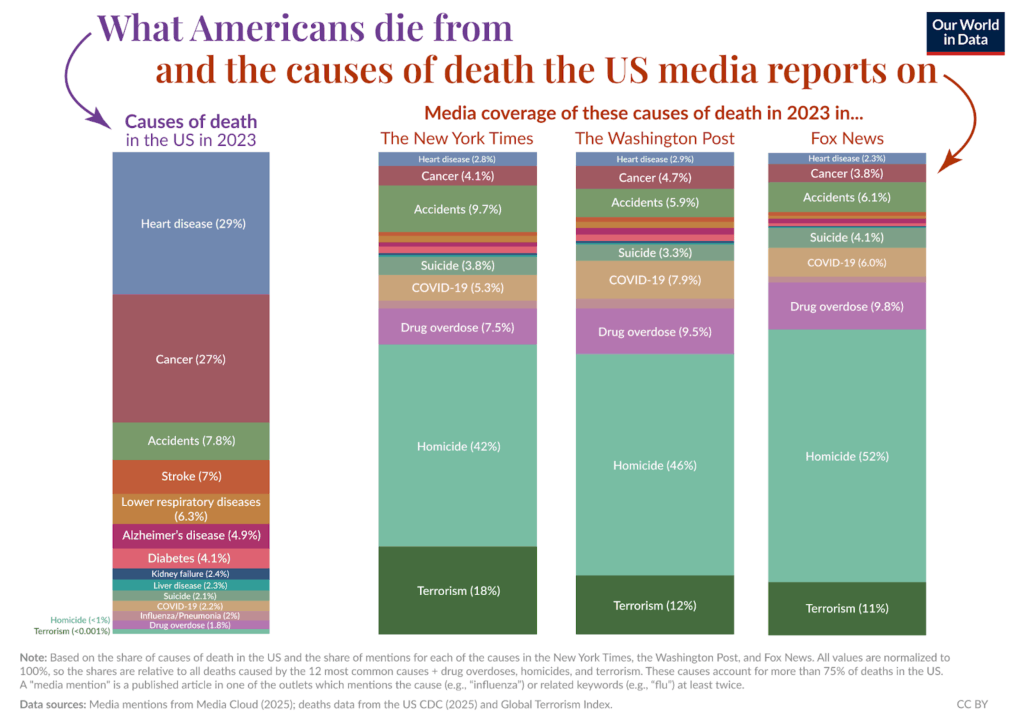
It’s no surprise that homicide and similar events tend to attract outsized coverage, so we can also assess the discrepancies between reported and actual mortality when narrowing the focus to just the twelve most common causes of death. Even then, the imbalance remains: accidents receive nearly as much coverage as heart disease and cancer combined, despite causing far fewer deaths, and deaths by other chronic conditions like dementia or metabolic disease barely registered at all.
Of course, popular media is in the business of boosting readership and viewership, and rare and sensational events certainly make for more attention-grabbing stories than the common and constant threat of cardiovascular disease. But as the original article points out, people often rely on the news to stay informed. If someone were to make their health decisions based on media coverage alone, they might never leave home for fear of homicide or terrorism, while ignoring the far greater—and often modifiable—risks reflected in their lab results. If your goal is to stay genuinely informed about your health, it’s worth seeking information from sources designed for accuracy, not attention.
Turning the lens on ourselves
Curious about how our own content compared, we decided to run a similar analysis for 2023. We reviewed everything we released that year—weekly emails, guest interviews, premium articles, “Ask Me Anything” podcast episodes, and special releases—to see how closely our focus aligned with real-world health risks.
We followed a similar approach to the Our World in Data article, though our review was manual and more qualitative rather than automated. Specifically, we reviewed each piece of content for its main intents and focuses of discussion. This made some boundaries looser—for instance, grouping discussions of depression or PTSD under suicide—and others tighter, such as excluding pieces that mentioned cancer multiple times but only as an analogy. Overall, it was a good-faith manual assessment prioritizing accuracy.
Going in, we expected to diverge sharply from mainstream media—after all, we don’t cover topics like terrorism or homicide. What we didn’t know was how our coverage would align with actual causes of death.
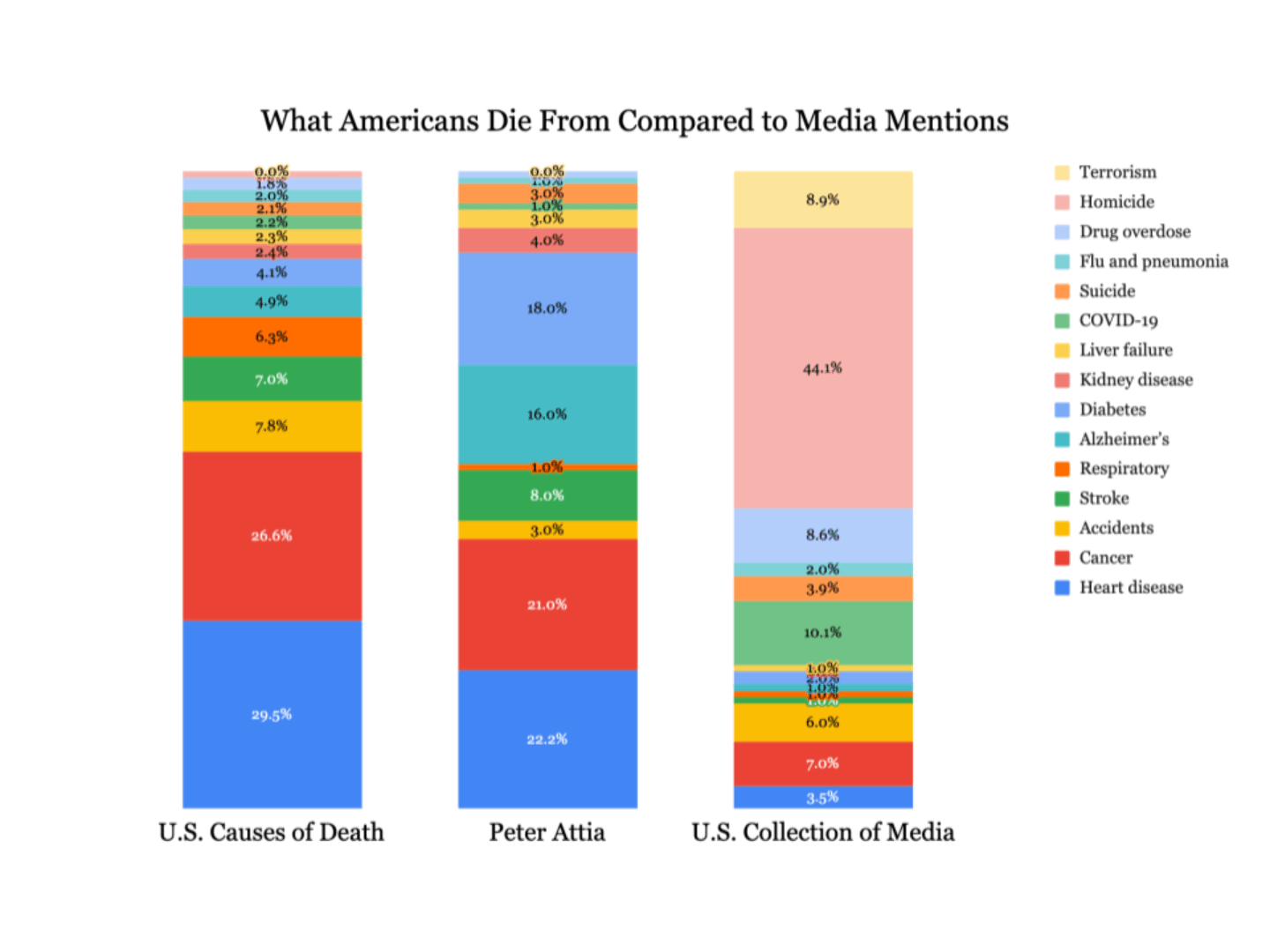
When we compared our 2023 coverage on the 15 causes of death from the original article (the 12 leading causes plus homicide, drug overdose, and terrorism) with U.S. mortality data, we found a strong correspondence between what we emphasize and what most often drives mortality—especially heart disease, cancer, and other forms of chronic illness. Among the pieces that fell within this set of 15 causes, heart disease and cancer together accounted for 43% of our coverage, more closely mirroring their 56% share of U.S. deaths—and vastly exceeding the mere 7% they receive in mainstream media.
Other chronic conditions, including Alzheimer’s, diabetes, kidney disease, and liver disease, made up 41% of our coverage, compared with about 14% of U.S. deaths within this set. That emphasis reflects a deliberate choice: many of these conditions develop over years and are at least partly modifiable through early detection, lifestyle changes, or preventive care. We dedicate more space to them because readers can actually do something about them—manage blood sugar, support cardiovascular health, or recognize early cognitive decline—unlike the catastrophic, often random events that dominate most news cycles.
Accidents, COVID-19, influenza, pneumonia, suicide, and drug overdose together accounted for only a small fraction of our 2023 coverage within this set of causes, generally falling in the 1–3% range. Homicide and terrorism received no coverage at all, despite their dominance in mainstream news—a reflection of our commitment to prioritize enduring, health-relevant risks that we have the power to mitigate instead of horrific headlines about rare and typically unpredictable potential causes of death. You can see the full comparison in Figure 2 below. Rather than focus on the three outlets highlighted in the original article, we drew from the broader range of U.S. media sources included in the article’s extended methods.
The bottom line
Compared to the constant threat of cancer or heart attacks, homicide and terrorism are largely random events. Indeed, it’s precisely because they’re so unpredictable and unfamiliar (that is, as a day-to-day situation in which we might find ourselves) that they evoke such a strong emotional response, and this same emotional response is what drives marketable mainstream headlines (not to mention horror film franchises).
But our goal is different from that of many media outlets. We aim to empower individuals with information that they can use to protect themselves from far more predictable—and far more likely—causes of death. Heart disease, cancer, and chronic metabolic or neurodegenerative diseases aren’t random events; they’re shaped by choices, environments, risk factors, and systems we can understand and improve. Prioritizing what’s most impactful for long-term health and lifespan often comes at a cost to us—reminding folks to exercise and keep up with cancer screenings doesn’t exactly make for great click-bait—but we began this enterprise as a humble attempt to help our audience improve their health, and that’s how we intend to continue it. Indeed, where our coverage does diverge from real mortality statistics, it is typically because we are choosing to focus on the most modifiable factors—changes you can make to shape your health.
There’s nothing wrong with being drawn toward news articles on the latest mass shooting or terrorist attack, but just as we need to keep a grounding in reality when it comes to viewing fictional threats from slasher films or creature features, we need to keep in mind that the coverage distribution in mainstream media is likewise not representative of the real threats to your health. So by all means, continue keeping up-to-date with your favorite news outlets, but when it comes to your health, it’s important to supplement these sources with outlets that prioritize accuracy over attention.
For a list of all previous weekly emails, click here.
References
1. Ritchie H, Acisu T, Mathieu E. Does the news reflect what we die from? Our World in Data. Published online October 6, 2025. Accessed November 5, 2025. https://ourworldindata.org/does-the-news-reflect-what-we-die-from

